
A 1099 home loan is a mortgage that lets an independent contractor or freelancer qualify using income reported on their Form 1099s, rather than relying only on the bottom line of their tax returns. Most 1099-only programs are Non-QM (non-qualified mortgage) loans offered by private wholesale investors, and each investor sets its own rules for how much 1099 history it wants, how it treats business expenses, and what current-year proof it needs. The Texas Mortgage Pros is a mortgage broker, so we compare those investors for you.
TL;DR
- A 1099 home loan can fit independent contractors, freelancers and commission earners who are paid on Form 1099-NEC and whose tax returns understate what they actually take home after write-offs.
- Programs commonly review your 1099 earnings over a set lookback period, apply an expense factor to the gross amount and turn the result into monthly qualifying income. The method varies by investor.
- Expect to show current-year proof that the work is continuing, such as recent invoices, contracts, platform earnings records or bank statements.
- Most 1099-only loans are Non-QM. They are not government-insured, and credit, reserve, down payment and property rules vary by investor.
- Conventional loans can also use 1099 income, but they usually qualify you on the net income from your tax returns, which is why many contractors compare both paths.
What is a 1099 home loan?
The IRS uses Form 1099-NEC to report nonemployee compensation, the pay a business sends to someone who is not on its payroll. If you work as an independent contractor or provide services to other businesses, the IRS generally considers you self-employed. That matters for a mortgage because self-employed income is documented differently from a W-2 paycheck.
Every mortgage still has to show that you can repay it. The Consumer Financial Protection Bureau’s ability-to-repay rule (Regulation Z, 12 CFR 1026.43) requires a reasonable, good-faith determination of a borrower’s ability to repay based on verified income or assets. A 1099 program meets that standard by verifying your 1099 earnings and current work instead of reading income only from Schedule C. “1099-only” describes the income documentation. It doesn’t mean a light review: we still underwrite your credit, assets, debts, and the property.
Who a 1099 home loan can suit in Texas
- Independent contractors paid by one or more businesses on Form 1099-NEC, including consultants, IT and engineering contractors, and construction trades.
- Real estate agents and other commission earners whose brokerage pays them on a 1099.
- Oilfield and energy-service contractors who work project-to-project for several operators across the state.
- Travel nurses and healthcare contractors paid on assignment agreements rather than as staff.
- Freelancers and creatives with recurring clients, from marketing and design to video and writing.
- Rideshare, delivery, and platform workers, although high vehicle and operating costs may make another documentation path a better fit.
A job title alone doesn’t determine fit. What matters is whether you can document your 1099 history and current work under an available program. If you earn both W-2 and 1099 income, each source is usually reviewed under its own rules.

How 1099 income is commonly calculated
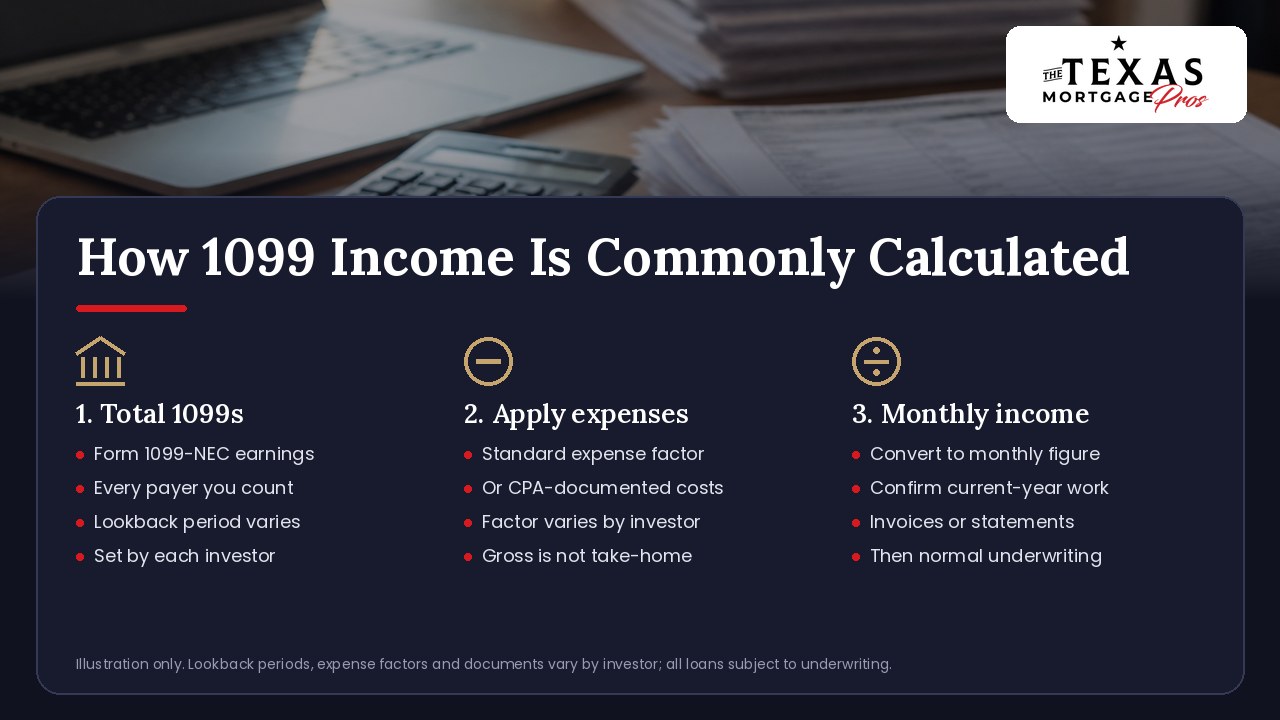
There is no single formula, but many 1099-only programs follow a similar structure:
- Total your 1099 earnings for the lookback period the investor requires. Some programs look at a shorter history, and others want more, so the number of forms you need varies by investor.
- Apply an expense factor. Gross 1099 pay isn’t the same as the money you keep, so investors commonly subtract a standard expense factor rather than using your full gross. The factor can vary by investor and occupation, and some programs let a CPA or tax preparer document your actual expenses instead.
- Convert the result to a monthly figure and confirm the income is continuing with current-year documentation.
The monthly figure then goes through normal underwriting with your debts, credit, and reserves. Because investors use different lookback periods and expense factors, the same set of 1099s can produce different qualifying income from one investor to the next. That is why comparing investors matters.
Documents to gather before you apply
- Your Form 1099-NEC forms for the period the investor requires, from every payer you want counted.
- Current-year proof of income, such as recent invoices, signed contracts or assignment agreements, platform earnings statements,s or bank statements showing the deposits.
- A CPA or tax preparer letter, if the program asks for one,ne to confirm your business or expenses. A letter supports the file; it does not replace the documents the investor requires.
- Asset statements for the funds you will use for the down payment, closing costs, and any required reserves.
- Identification and a short written explanation of any gap, a big drop in income, or a change of clients or work type.
What to expect with a Non-QM 1099 loan
- Credit still matters. Credit history and score requirements apply, and they vary by investor.
- Reserves. Many investors want verified funds left over after closing.
- Down payment. Requirements are often higher than on many conventional or FHA loans and depend on the investor, credit, property, and occupancy.
- Property and occupancy. Many programs allow a primary home, second home, or investment property, but eligibility depends on the investor.
- Terms vary. Non-QM pricing and terms are set by each investor and are not guaranteed. Ask for a Loan Estimate to compare offers on paper.
1099 loans vs. conventional, bank statement and asset-based options
Conventional loans: Fannie Mae’s guidelines for self-employed borrowers (Selling Guide B3-3.5-01) generally call for a two-year history of earnings, verified with signed federal tax returns or IRS transcripts. A shorter history may be considered if your most recent returns show a full 12 months of self-employment and you have prior experience in the same line of work. Because conventional income usually comes from your returns after deductions, heavy write-offs can lower your qualifying income. If your net income is strong, it may be worth comparing a conventional loan first.
Bank statement loans: instead of 1099 forms, a bank statement loan estimates income from deposits into your personal or business accounts. It can suit contractors with many small payers or income not fully captured on 1099s.
Profit and loss loans: some investors qualify self-employed borrowers with a profit and loss statement prepared by a CPA or tax preparer, which has its own documentation rules.
Asset depletion: if your savings are stronger than your income, read our guide to asset depletion loans in Texas.
Non-QM loans don’t carry the legal presumption of compliance that a qualified mortgage does, so investors still must make a good-faith ability-to-repay determination.
How a mortgage broker shops 1099 home loans
The Texas Mortgage Pros does not set Non-QM guidelines. We are a mortgage broker licensed in Texas, so we can submit your scenario to several wholesale investors and compare how many months of 1099s each one wants, what expense factor it applies, whether it accepts a CPA letter, and its credit, reserve, and property rules. One investor may treat a real estate agent’s commissions differently from a travel nurse’s assignment pay, or count multiple payers differently. Seeing those differences side by side helps you choose before you commit. Learn more on our 1099 home loans page and our Non-QM loans overview.
Questions to ask before choosing a 1099 program
- How many months or years of 1099s does this investor require, and from how many payers?
- What expense factor does it apply, and can a CPA letter document my real expenses instead?
- What current-year documents will prove my income is continuing?
- How does it treat a recent change in clients, a gap, or a drop in income?
- What credit, reserve, occupancy, and property requirements apply?
FAQ: 1099 home loans in Texas
Q: Can I get a home loan with only 1099 income?
A: It may be possible under some Non-QM programs. “1099-only” means your income is documented with 1099s instead of tax-return income, but the investor still reviews your current work, credit, assets, and the property. Guidelines vary by investor.
Q: How do 1099 home loans calculate income?
A: Programs commonly total your 1099 earnings over a required lookback period, apply an expense factor or a CPA-documented expense figure, and convert the result to monthly qualifying income. The lookback period and expense factor vary by investor.
Q: How many years of 1099s do I need?
A: It depends on the program. Some non-QM investors require less history, while others require more, plus proof that the work continues in the current year. Conventional loans generally look for two years of self-employment history, with limited exceptions.
Q: Do I need a CPA letter?
A: Not always. Some programs ask for one to confirm your business or expenses; others do not. A letter supports your file but does not override the investor’s documentation rules.
Q: Are 1099 home loans government-backed?
A: No. Non-QM 1099 loans are not insured by FHA, VA, or USDA and are made under each investor’s own guidelines, subject to underwriting.
Talk with a Texas mortgage broker about 1099 home loans
If your 1099s tell a stronger story than your tax returns, a 1099 home loan may be worth a look. The Texas Mortgage Pros can compare options from the wholesale investors we work with, subject to qualification and program availability. Call (877) 280-4833, apply online, or contact us.
Official sources
- Internal Revenue Service: About Form 1099-NEC, Nonemployee Compensation (linked above)
- Consumer Financial Protection Bureau: Regulation Z, 12 CFR 1026.43, Minimum standards for transactions secured by a dwelling (ability-to-repay rule) (linked above)
- Consumer Financial Protection Bureau: What is a Qualified Mortgage? (linked above)
- Fannie Mae Selling Guide: B3-3.5-01, Underwriting Factors and Documentation for a Self-Employed Borrower (12/13/2023) (linked above)
- Texas Department of Savings and Mortgage Lending: mortgage company and residential mortgage loan originator licensing (sml.texas.gov)
The Texas Mortgage Pros is not affiliated with or endorsed by the Internal Revenue Service, the Consumer Financial Protection Bureau, Fannie Mae, HUD, FHA, VA, USDA, or the Texas Department of Savings and Mortgage Lending, and this is not a government document.
The Texas Mortgage Pros, LLC | Company NMLS #2665861 | Gerry Nicodemus, NMLS #286371 | Equal Housing Opportunity | www.nmlsconsumeraccess.org | (877) 280-4833
Equal Housing Opportunity. We do business in accordance with federal fair lending laws.