

An asset depletion loan is a mortgage that lets you qualify using the money you already have instead of a paycheck. Instead of counting wages from pay stubs or income from tax returns, the underwriter takes your verified liquid assets, such as savings, brokerage, and eligible retirement accounts, and converts them into monthly qualifying income. asset depletion loans are Non-QM (non-qualified mortgage) loans offered by private wholesale investors, each with its own guidelines. The Texas Mortgage Pros is a mortgage broker, so we compare those investors for you.
TL;DR
- Asset depletion turns verified liquid assets into qualifying income, which can help retirees, high-net-worth borrowers, investors and people between jobs whose tax returns do not show their real financial strength.
- A common method: eligible assets, minus funds needed to close and required reserves, divided by a set number of months. The method and the number of months vary by investor.
- Retirement and investment accounts are often counted at a discount, and you will usually need recent account statements.
- Most asset depletion loans are Non-QM. They are not government-insured, and guidelines and terms vary by investor. Expect larger reserve and down payment requirements than many standard loans.
- Conventional loans have only a narrow version of this (Fannie Mae’s “employment-related assets” rule), so many borrowers end up in Non-QM.
What is an asset depletion loan?
Every mortgage requires proof that you can repay it. Federal rules from the Consumer Financial Protection Bureau, known as the ability-to-repay rule (Regulation Z, 12 CFR 1026.43), require a reasonable, good-faith determination that a borrower can repay, and they allow that determination to rely on current or reasonably expected income or assets. Asset depletion programs build on that idea. Instead of asking “how much do you earn each month?”, the underwriter asks “how much income could your verified assets reasonably support over time?”
You do not usually have to sell your investments or move money to use this approach. The assets are documented and used in the calculation. Investors may require that the funds remain available and not be tied to another debt.
Who an asset depletion loan can suit
- Retirees with meaningful savings or retirement balances but modest Social Security or pension income.
- High-net-worth borrowers whose taxable income is low on paper because their wealth sits in investments.
- People between jobs or recently retired who have assets but no current paycheck to document.
- Real estate and market investors whose income is irregular but whose account balances are strong.
- Self-employed borrowers with large write-offs, who may also want to compare a bank statement loan.

What assets typically count
Each investor publishes its own list, but asset depletion programs commonly look at:
- Checking, savings and money market accounts, and certificates of deposit; bank-statementage accounts holding stocks, bonds and mutual funds. These are often counted at a discount because market values move.
- Retirement accounts such as a 401(k) or IRA, usually only if you can access the funds. Many investors count less than the full balance to allow for tax-discounted changes.
Assets that fluctuate more or are impossible to use include business accounts you do not fully own, restricted or unvested stock, cryptocurrency (investor-specific), and funds borrowed from someone else. Large or unusual deposits will need a paper trail.
Typical documentation: recent statements for every account you want counted (usually at least the most recent two months, sometimes more), identification, proof of ownership, an explanation of large deposits, and any retirement plan terms showing how you can withdraw funds. Your credit report, the appraisal, and homeowners insurance are still part of the file.
How investors commonly calculate asset depletion income
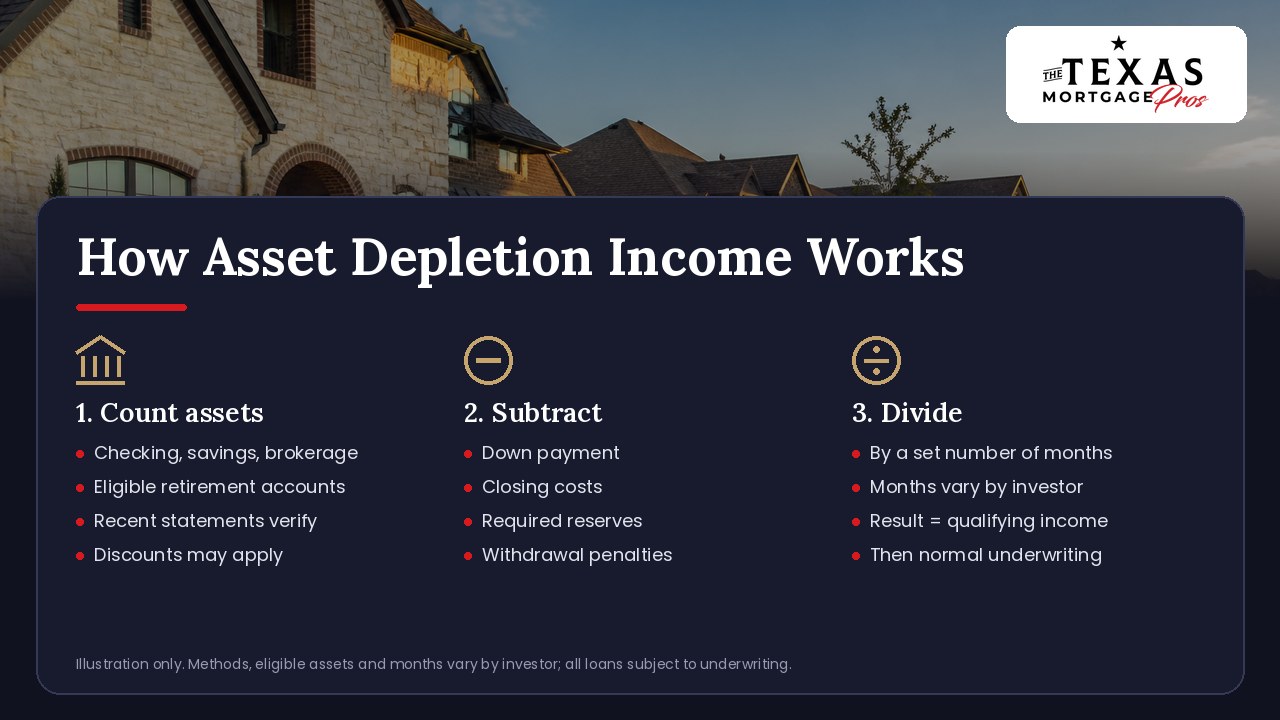
There is no single formula. A common structure looks like this:
- Add up eligible assets, applying any discounts the investor uses for brokerage or retirement accounts.
- Subtract the money you will use for the down payment, closing costs, and any required reserves, plus any withdrawal penalties if you include retirement funds.
- Divide what is left by a set number of months. Some investors use a fixed period; others use the loan term. The number of months is one of the biggest differences between programs.
The result is treated as monthly qualifying income and is reviewed with your other income and debts in normal underwriting. Because investors use different discounts and divisors, the same balances can produce different results from one investor to the next. That is exactly why comparing investors matters.
What to expect with a Non-QM asset depletion loan
- Larger reserves. Investors often want you to keep a cushion of verified funds after closing.
- A large Down payment requirement is often higher than on many conventional or FHA loans and depends on the investor, credit, and property.
- Credit still matters. Credit history and score requirements apply, and they vary by investor.
- Property and occupancy. Many programs allow a primary home, second home or investment property, and single-family homes, condos and townhomes, but eligibility depends on the investor. If you are buying a condo, read our guide to warrantable vs. non-warrantable condos.
- Homesvary. Non-QM property terms are set by each investor and are not guaranteed. Ask for a Loan Estimate to compare offers on paper.
Asset depletion vs. conventional and FHA loans
Conventional loans: Fannie Mae’s Selling Guide has a narrow version called Employment Related Assets as Qualifying Income (B3-3.4-06). It is limited to assets such as retirement accounts and severance, generally excludes checking and savings accounts, allows only purchases and limited cash-out refinances on a principal residence or second home, has tighter loan-to-value limits (with a higher limit when the asset owner is 62 or older), and divides net assets by the loan term in months. If you meet those rules, you may want to compare a conventional loan first. See our conventional loan page.
FHA loans: FHA loans are government-insured and follow HUD’s income and asset rules, which focus on documented, stable income. Borrowers who qualify on income may want to compare our FHA loan options.
Non-QM asset depletion: broader asset types, flexible calculation methods and more property options, but not government-insured, with guidelines and terms that vary by investor. Non-QM loans don’t carry the legal presumption of compliance that a qualified mortgage does, so investors still must make a good-faith ability-to-repay determination.
How a mortgage broker shops asset depletion loans:
Texas Mortgage Pros does not set Non-QM guidelines. We are a mortgage broker licensed in Texas, so we can submit your scenario to several wholesale investors and compare how each one counts your assets, which accounts are eligible, how many months they divide by, and their reserve, credit, and property rules. One investor may discount a brokerage account more than another, or treat a retirement account differently. Comparing them side by side helps you see your options before you commit. Learn more on our asset depletion loan page and our Non-QM loans overview.
Steps to apply for an asset depletion loan in Texas
- Gather statements for every account you want counted, plus ID and retirement plan details.
- Talk with a broker about your goals, the property type and how you plan to occupy it.
- Get your scenario compared across wholesale investors, including how each calculates your qualifying income.
- Apply and review your Loan Estimate for the program that fits.
- Underwriting and appraisal. Answer questions about deposits and keep your accounts intact until closing.
- Review your Closing Disclosure before you sign, and confirm any wire instructions by phone using a number you found yourself.
FAQ: asset depletion loans in Texas
Do I have to sell my investments to use an asset depletion loan?
Usually not. Assets are documented and used to calculate qualifying income. You will still need funds to close, and investors may require that counted assets remain available.
Can I use my 401(k) or IRA?
Often yes, if you can access the funds. Many investors count less than the full balance to account for taxes, penalties, or market changes, and rules vary by investor and age.
Can retirees with little income qualify?
Asset depletion was built for that situation, but qualification depends on the assets, credit, property and investor guidelines. Social Security or pension income can often be combined with asset income.
Is an asset depletion loan the same as a bank statement loan?
No. A bank statement loan uses deposits in the investor’s accounts to estimate income, usually for self-employed borrowers. Asset depletion uses the balances you already hold.
Are asset depletion loans government-backed?
No. Non-QM asset depletion loans are not insured by FHA, VA or USDA and are made under each investor’s own guidelines, subject to underwriting.
Talk with a Texas mortgage broker about asset depletion
If your savings tell a stronger story than your tax returns, an asset depletion loan may be worth a look. The Texas Mortgage Pros can compare options from the wholesale investors we work with, subject to qualification and program availability. Call (877) 280-4833, apply online, or contact us.
Official sources
- Consumer Financial Protection Bureau: Regulation Z, 12 CFR 1026.43, Minimum standards for transactions secured by a dwelling (ability-to-repay rule) (linked above)
- Consumer Financial Protection Bureau: What is a Qualified Mortgage? (linked above)
- Fannie Mae Selling Guide: B3-3.4-06, Employment Related Assets as Qualifying Income (03/04/2026) (linked above)
- Texas Department of Savings and Mortgage Lending: mortgage company and residential mortgage loan originator licensing (sml.texas.gov)
The Texas Mortgage Pros is not affiliated with or endorsed by the Consumer Financial Protection Bureau, Fannie Mae, HUD, FHA, VA, USDA or the Texas Department of Savings and Mortgage Lending, and this is not a government document.
The Texas Mortgage Pros, LLC | Company NMLS #2665861 | Gerry Nicodemus, NMLS #286371 | Equal Housing Opp,ortunity | www.nmlsconsumeraccess.org | (877) 280-4833
Equal Housing Opportunity. We do business in accordance with federal fair lending laws.