Freddie Mac Home Possible is a conventional mortgage that lets qualified buyers put down as little as 3%. Texas buyers can get it from lenders that offer it, as long as their income, the home, and their credit meet the program’s requirements. You do not need to be a first-time buyer to use it. Below we walk through who qualifies, what the loan costs, how it compares with other low-down-payment options, and where Texas assistance programs fit in.
TL;DR
- Home Possible is a Freddie Mac conventional loan with a 3% down payment and flexible sources for that money.
- Your qualifying income generally must be at or below 80% of the area median income (AMI) where the home is located.
- The home must be your primary residence, and you can cancel mortgage insurance later once you build enough equity.
- Texas’s My Choice Texas Home program offers Freddie Mac HFA Advantage with down payment and closing cost help of up to 5% of the loan.
- You apply through a lender, not Freddie Mac. A broker with many lenders can compare your options side by side.
Table of Contents
- What Home Possible is
- Is Home Possible available in Texas?
- Who qualifies
- The 3% down payment and where it can come from
- Mortgage insurance and other costs
- Combining Home Possible with Texas assistance
- Home Possible compared with other low-down-payment loans
- A step-by-step path for a Texas buyer
- Our perspective
- How we can help
- Common mistakes to avoid
- FAQ
- Sources
What Home Possible is
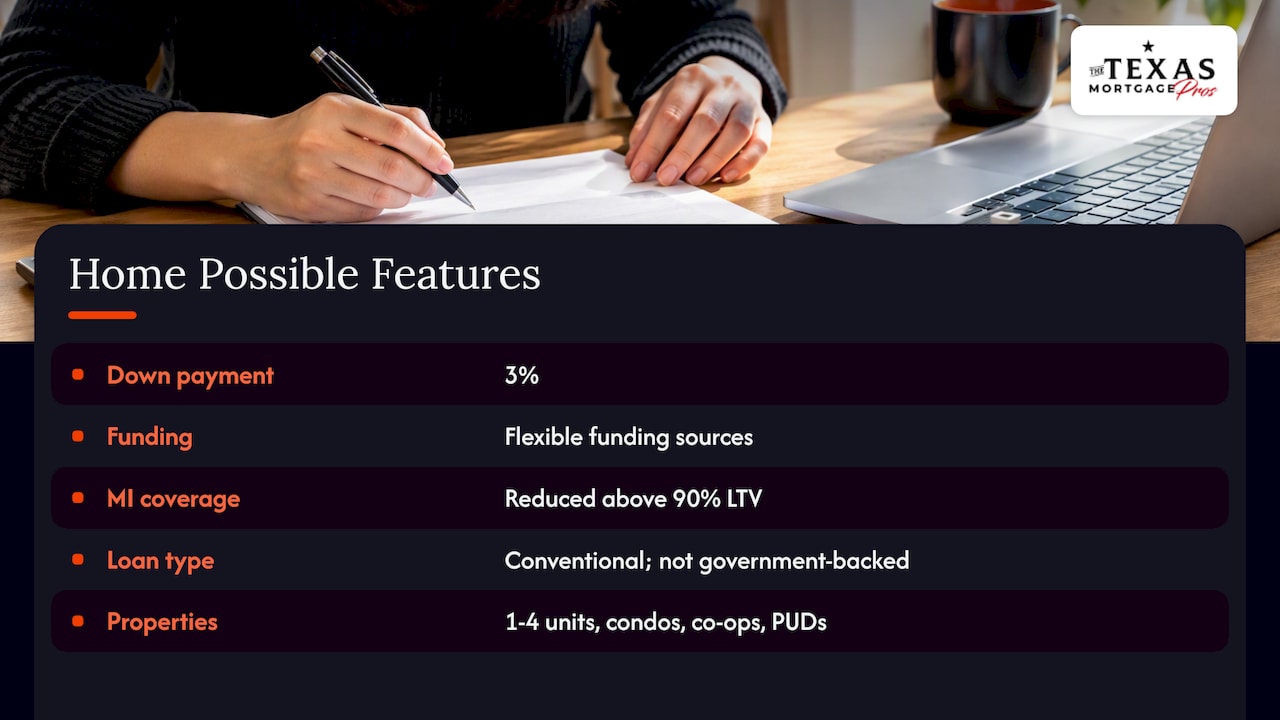
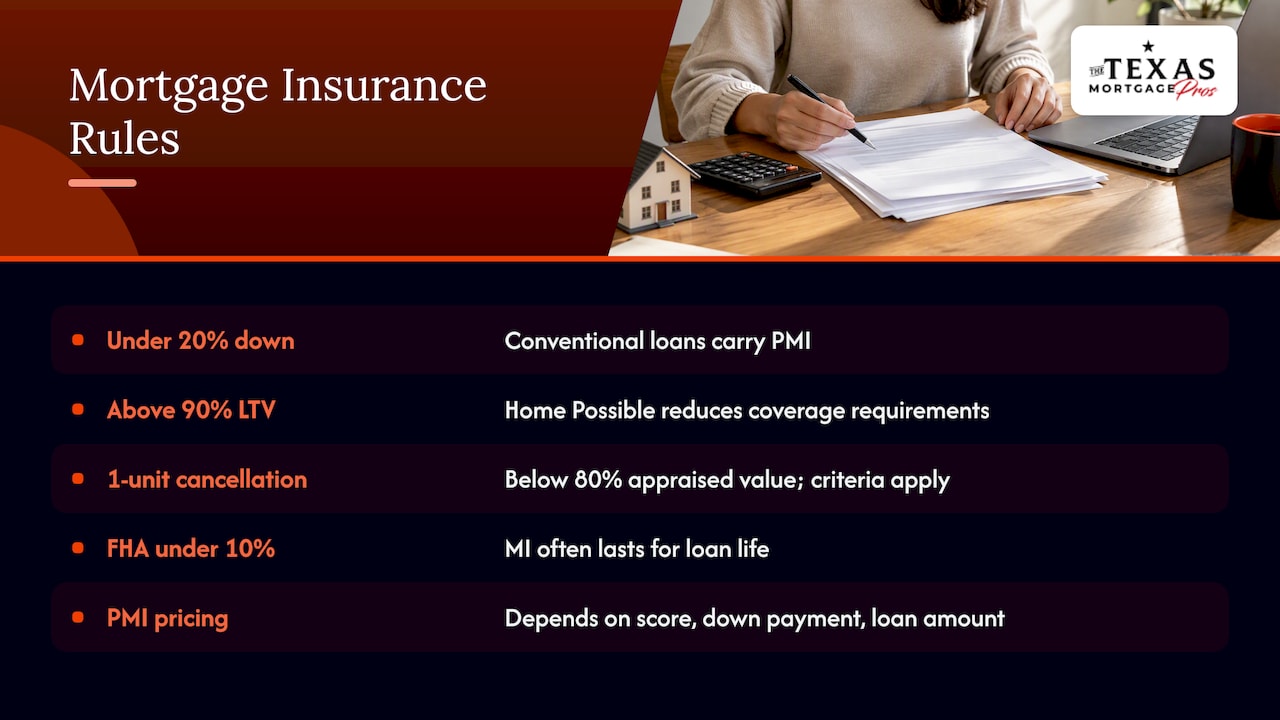
Freddie Mac does not lend directly to homebuyers. It buys mortgages from lenders and sets the rules those loans must follow. Home Possible is one of those rule sets, built for low- and very low-income borrowers. Freddie Mac describes the main features as a 3% down payment, flexible funding sources, and reduced mortgage insurance coverage requirements when the loan-to-value ratio is above 90%.
It is a conventional loan, not a government-backed one. That means no FHA-style upfront premium and no VA or USDA eligibility rules. It also means the loan is underwritten like any conventional loan, with Freddie Mac’s automated system, Loan Product Advisor, doing much of the review.
The program covers more than a standard single-family house. According to Freddie Mac, eligible properties include 1 to 4 units, condos, co-ops, and planned-unit developments; manufactured homes are also eligible with certain restrictions.
Is Home Possible available in Texas?
Yes. The program is national, so there is no separate “Texas version” of the loan itself. What changes by state is the income limit, because it depends on the area median income where the property sits. A household in Austin, Dallas, Houston, San Antonio, or a small rural county will each be measured against a different AMI figure.
For Texas buyers, the practical question is not whether the program exists but whether a lender in your market offers it and whether your numbers fit. That is where working with a broker helps. Not every lender offers every program, and the rates and fees on the same loan type can vary from one lender to the next.
Who qualifies
Four things decide eligibility: income, occupancy, credit, and property.
Income
Home Possible qualifying income is limited to 80% of the area median income. The limit depends on the county or census tract of the home you are buying, not where you live now. Freddie Mac provides the Home Possible Income and Property Eligibility Tool, where you enter the property location and qualifying income to see whether the loan fits. Final eligibility is determined through Loan Product Advisor or approved manual underwriting.
A useful detail: the income that counts is the qualifying income on the loan, which can differ from what you might assume. Your lender will calculate it from documentation. Self-employed buyers should expect the lender to average income over time, so talk to someone early if your tax returns show heavy write-offs.
Occupancy
Per Freddie Mac’s February 2026 Home Possible fact sheet, the property must be a primary residence with at least one borrower living in it. Occupying borrowers also must not have an ownership interest in more than two financed residential properties, including the one you are buying. So this is not a loan for investment properties, though it is not limited to first-time buyers.
Credit
The fact sheet says the credit reputation is acceptable when the Loan Product Advisor returns an Accept risk class. If a file goes to manual underwriting, the minimum indicator scores for 1-unit properties are 660 for fixed-rate purchases and 680 for ARMs or no-cash-out refinances, according to the same fact sheet. Individual lenders may set higher minimums, so it’s worth comparing more than one.
Property
The home has to be in the eligible property types listed above and meet standard appraisal and condition requirements. Condos and planned-unit developments are common in Texas metro areas, so check that your project is approved before you fall in love with a unit.
The 3% down payment and where it can come from
Three percent down is the headline, but the flexibility in where the funds come from is just as useful. Freddie Mac says the down payment can come from family, employer-assistance programs, secondary financing, or sweat equity. Gifts, grants, and other contributions can also count toward the down payment.
Here is what 3% looks like in practice. These are illustrations of the arithmetic, not quotes:
| Home price | 3% down payment | Loan amount before any mortgage insurance financing |
|---|---|---|
| $200,000 | $6,000 | $194,000 |
| $300,000 | $9,000 | $291,000 |
| $400,000 | $12,000 | $388,000 |
Remember that the down payment is only part of cash to close. Closing costs, prepaid taxes and insurance, and any inspection fees are in addition to that. That is why assistance programs matter, covered below.
Mortgage insurance and other costs
With less than 20% down, a conventional loan carries private mortgage insurance (PMI). Home Possible softens this in two ways. Coverage requirements are reduced for loans above 90% loan-to-value, and on 1-unit properties, you can cancel mortgage insurance once the balance drops below 80% of the home’s appraised value and you meet the cancellation criteria. Certain credit fees are also capped for eligible mortgages.
That cancellation feature differs from FHA loans, where mortgage insurance often stays for the life of the loan when you put less than 10% down. If you plan to stay in the home for years, ask your loan officer to show you the monthly payment now and the payment after PMI drops off.
PMI costs depend on your credit score, down payment, and loan amount. We do not publish a figure here because it is set by the insurer and the lender at the time of your quote.
Combining Home Possible with Texas assistance
Texas has a state housing finance agency, the Texas Department of Housing and Community Affairs (TDHCA), which runs the Texas Homebuyer Program. Its Lender Guide states that My Choice Texas Home offers Freddie Mac HFA Advantage, plus down payment and closing cost assistance of up to 5% of the mortgage loan.
The assistance comes as a second lien in one of two forms, per the same guide:
- a 30-year deferred repayable second lien, or
- a 3-year deferred forgivable second lien.
HFA Advantage is Freddie Mac’s product for state housing finance agencies. It is a close cousin of Home Possible, not the same loan, and the rules differ. So if you want Texas assistance, you would typically use that program’s loan rather than stacking it onto a standard Home Possible loan. Check the details with a participating lender.
TDHCA programs are delivered through approved participating lender partners, so you cannot apply to the state directly. Program terms, rates, and funding change, so confirm current details on the TDHCA site before you commit.
A simple way to think about the choice:
| Situation | Option to look at first |
|---|---|
| Income at or under 80% AMI, want the lowest possible down payment, no assistance needed | Home Possible |
| Need help with down payment and closing costs too | My Choice Texas Home (Freddie Mac HFA Advantage with assistance) |
| Higher income, little cash, flexible on mortgage insurance | Other conventional low-down options or FHA |
| Veteran with eligibility | VA loan, which has no required down payment for many borrowers |
| Rural property in an eligible area | USDA loan |
Home Possible compared with other low-down-payment loans
No one loan wins for every buyer. A fair comparison looks at four things: down payment, mortgage insurance, income limits, and credit flexibility.
- Home Possible: 3% down, cancellable mortgage insurance, income capped at 80% AMI, primary residence only.
- Other 3% conventional programs: similar down payment, with their own income rules. Some allow different borrower arrangements, such as non-occupant co-borrowers, so ask your lender which program fits your household.
- FHA: more forgiving on credit for some borrowers, but mortgage insurance costs differ and may last longer.
- VA: often the strongest option for eligible veterans and service members, with no monthly mortgage insurance.
- USDA: zero down in eligible rural areas, with income and location limits.
Because we work with more than 70 lenders, we can run your scenario through several options instead of giving you just one. You can see the loan types we handle on our loans page.
A step-by-step path for a Texas buyer
- Check your numbers. Add up everyone’s gross monthly income on the loan, and pull your credit reports.
- Use the eligibility tool. Enter the address or area you are shopping in and your qualifying income into Freddie Mac’s eligibility tool.
- Get pre-qualified. You always apply for a Freddie Mac loan through your lender, so the next step is a conversation with a loan officer or broker.
- Compare more than one quote. Rates, fees, and PMI pricing differ. Ask for a written Loan Estimate from each.
- Ask about assistance. Find out whether a Texas program would lower your cash to close.
- Shop with a pre-approval in hand, then move to appraisal, underwriting, and closing.
Our perspective
Most buyers who search for Home Possible are really asking one thing: “Can I buy a home without a huge pile of cash?” In Texas, the answer is often yes, but the best route is not always the one with the best-known name. We see buyers who assume they are over the income limit when they are not, and buyers who assume they qualify for a program that does not fit their property or household.
What helps most is looking at the whole picture at once: down payment, monthly payment with and without mortgage insurance, closing costs, and any Texas assistance. Because we work with a large network of lenders, we can fight for the right rate and structure for your situation instead of fitting you into one lender’s menu. First-time buyers, veterans, self-employed borrowers, and repeat buyers all have different needs, and the loan should follow the person.
One piece of advice we repeat often: do not wait to start the conversation. Learning your options six months before you shop costs nothing and can change which home you aim for.
— Michelle
How we can help
We are a Texas mortgage brokerage. We help buyers compare conventional, FHA, VA, and USDA loans; explore first-time homebuyer programs and down payment assistance; and walk through pre-qualification to closing. If you are considering a low-down-payment loan, start with our first-time buyer and assistance options, and tell us about your income, the area you are shopping in, and how much cash you have saved.
If you are self-employed, a veteran, or buying something unusual, like land or a manufactured home, we also offer specialty loan products that may fit better than a standard program.
Common mistakes to avoid
- Guessing at the income limit. It depends on the home’s county, so check the tool for each area you consider.
- Forgetting closing costs. A 3% down payment does not cover them. Ask early about assistance or seller credits.
- Applying to one lender only. Pricing for the same program can differ by lender.
- Taking on new debt mid-process. A car loan or new credit card between pre-approval and closing can change your approval.
- Ignoring how payments change over time. If mortgage insurance can be canceled, plan for that date.
- Assuming the program is for first-timers only. It is not, though the ownership rules above apply.
FAQ
Do I have to be a first-time homebuyer to use Home Possible?
No. According to Freddie Mac’s fact sheet, occupying borrowers must not own more than two financed residential properties, including the one being bought. Many repeat buyers and buyers who sold a home can qualify. Texas assistance programs have their own rules, so check those separately.
What credit score do I need for Home Possible?
There is no single number. Approval depends on Freddie Mac’s Loan Product Advisor returning an Accept risk class. In manual underwriting for 1-unit properties, Freddie Mac lists minimum indicator scores of 660 for fixed-rate purchases and 680 for ARMs or no-cash-out refinances. Lenders can set stricter minimums, so quotes vary.
Can I use gift money for the down payment?
Often, yes. Freddie Mac says the 3% down payment can come from family, employer-assistance programs, secondary financing, or sweat equity. Your lender will ask for documentation, such as a gift letter and proof of the transfer.
Can I get Texas down payment assistance with Home Possible?
Texas’s My Choice Texas Home program pairs Freddie Mac HFA Advantage with up to 5% of the loan in assistance. That is a related but separate product from Home Possible. A lender in the program can tell you which one gives you the lower total cost.
Does Home Possible have mortgage insurance for the whole loan?
Not necessarily. On 1-unit properties, mortgage insurance can be canceled after the loan balance falls below 80% of the home’s appraised value and cancellation criteria are met. Ask your lender how that applies to your loan and when you would likely reach that point.
Sources
- Home Possible, Freddie Mac Single-Family
- Home Possible fact sheet, Freddie Mac
- Home Possible Income and Property Eligibility Tool, Freddie Mac
- Lender Guide, Texas Department of Housing and Community Affairs
- Finding the Right Freddie Mac Mortgage Product for You, Freddie Mac