TSAHC down payment assistance can give eligible Texas buyers up to 5% of their loan amount toward a down payment and closing costs. It comes as a grant or second lien, and you get it through a participating lender, not by applying directly to TSAHC. Below we explain how it works, who qualifies, how it differs from the TDHCA and SETH programs, and what to weigh before you use it.
TL;DR
- TSAHC offers up to 5% of your loan amount for down payment and closing costs, as a grant, a deferred forgivable second lien, or a deferred repayable second lien.
- Minimum FICO scores are 620 for government loans and 640 for HFA conventional loans, plus income and sales-price limits.
- TDHCA (My First Texas Home, My Choice Texas Home) and SETH 5 Star Texas offer similar 5% assistance with different rules, so compare before you commit.
- Assistance usually comes with a specific first mortgage, so the interest rate matters as much as the 5%.
- You apply through an approved lender. We work with more than 70 lenders and can help you find the program that fits.
Table of Contents
- What TSAHC down payment assistance is
- How much you can receive and in what form
- Who qualifies
- TSAHC, TDHCA and SETH compared
- The downsides to weigh
- How to apply
- Our perspective
- Getting matched with the right program
- FAQ
- Sources
What TSAHC down payment assistance is
The Texas State Affordable Housing Corporation (TSAHC) is a nonprofit created by the Texas Legislature. Its homebuyer programs pair a mortgage with down payment assistance (DPA) to cut the cash you need at closing.
TSAHC runs two main programs:
- Homes for Texas Heroes is for eligible educators, law-enforcement and public-security officers, firefighters and EMS personnel, veterans or active military, correctional officers, and nursing or allied-health faculty.
- Home Sweet Texas is for buyers who do not qualify through one of those professions. According to TSAHC, it is open to low- and moderate-income households, including first-time and repeat buyers.
The assistance is not a standalone check. It is attached to a first mortgage that a participating lender originates under the program. That is why most of the practical questions come down to the loan, not the assistance.
How much you can receive and in what form
Eligible borrowers can receive up to 5% of the loan amount. TSAHC lets you choose among three forms of assistance:
- A grant.
- A deferred forgivable second lien.
- A deferred repayable second lien.
The form changes what you owe later, so it is worth understanding each one.
| Form | What happens later |
|---|---|
| Grant | Not repaid, as long as the first mortgage is not refinanced or paid off in the first six months after closing |
| 3-year deferred forgivable second lien | Forgiven in full on the third anniversary of the note date; repaid if you sell, refinance, or transfer the home before then |
| Deferred repayable second lien | Repaid when you sell, transfer, pay off, or refinance the first lien |
The terms come from TSAHC’s DPA guidelines and its repayment FAQ.
A worked example
Say you buy a $300,000 home with a $290,000 loan. Five percent of the loan is $14,500. That could cover most of a 3% down payment plus closing costs. The example is arithmetic, not a quote: your actual amount depends on your loan, the program, and the assistance type you choose.
What the money can be used for
TSAHC requires that DPA funds go only toward permitted closing-related costs. The guidelines prohibit using them to repay debt or to give you cash back at closing.
Who qualifies
Requirements vary by program and loan type, and TSAHC can update them. Confirm the current numbers with a lender before you plan around them. These are the main tests.
Credit score
As of September 2026, TSAHC requires a minimum FICO score of 620 for government loans and 640 for HFA conventional loans. A lender may set a higher minimum of its own.
Income
Income limits depend on the county and household size. TSAHC says they are based on area median income: households up to about 80% are generally considered low-income, and up to roughly 150 to 170% are considered moderate-income, per its Home Sweet Texas page. A buyer in a high-cost metro and a buyer in a rural county face different ceilings.
First-time buyer status
Home Sweet Texas does not require you to be a first-time buyer. First-time buyers may also apply for a Mortgage Credit Certificate, subject to income and sales-price limits. An MCC is a tax credit, not cash for your down payment, so treat it as a separate benefit that can help your budget after closing.
ProfessionAt
Homes for Texas Heroes, profession matters. If you are a teacher, firefighter, veteran, or one of the other listed roles, ask your lender to price that program and Home Sweet Texas side by side.
TSAHC, TDHCA and SETH compared
Buyers often search for all three names together because each offers a similar headline: up to 5% assistance. The details differ.
| TSAHC | TDHCA | SETH 5 Star Texas | |
|---|---|---|---|
| Programs | Home Sweet Texas, Homes for Texas Heroes | My First Texas Home, My Choice Texas Home | 5 Star Texas Homebuyer Assistance |
| Assistance | Up to 5% | Up to 5% | Up to 5% |
| Forms | Grant, 3-year forgivable lien, deferred repayable lien | 3-year forgivable lien, 30-year deferred repayable lien | 3-year forgivable lien, 30-year deferred repayable lien |
| First-time buyer required | No for Home Sweet Texas | Yes for My First Texas Home; no for My Choice Texas Home | No |
| Minimum FICO | 620 government, 640 HFA conventional | Set in program and lender guidelines | 640 |
TDHCA
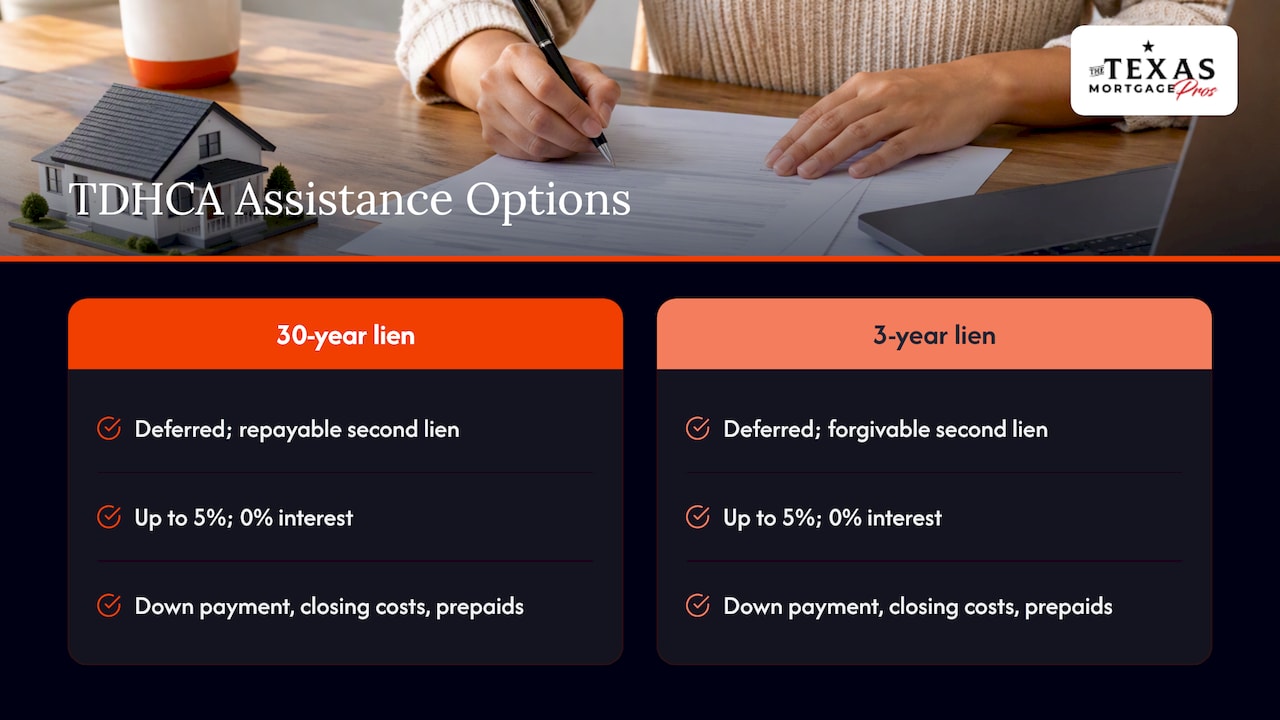
The Texas Department of Housing and Community Affairs runs the Texas Homebuyers Program. My First Texas Home gives first-time buyers a 30-year mortgage with down payment help. My Choice Texas Home is similar without the first-time buyer requirement. Per TDHCA’s lender guide, assistance of up to 5% comes as a 30-year deferred repayable second lien or a 3-year deferred forgivable second lien, both at 0% interest. It can go toward the down payment, closing costs, and prepaids.
SETH
SETH’s 5 Star Texas program offers up to 5% for down payment and closing costs with a 30-year fixed-rate mortgage. It supports FHA, USDA, VA, and conventional loans. You need a 640 credit score, must meet income limits, and must complete SETH’s online homebuyer education course. First-time status is not required. SETH says the program covers most of Texas but excludes the city limits of El Paso, McKinney, and Grand Prairie. The assistance is a second loan with no payments: the three-year option is forgiven after three years, and the 30-year option is repaid on sale, refinance, or at the end of the term.
The downsides to weigh
Down payment assistance is useful, but it is not free money in every form. Ask about these before you choose.
- The interest rate. Programs that bundle assistance with a first mortgage can carry a different rate than a standard loan. One ranking page puts the tradeoff plainly: the grant is offset by a higher rate on the loan. Compare the monthly payment, not just the cash at closing.
- Repayment triggers. A forgivable lien is only forgiven if you stay. Selling, refinancing, or moving out within three years can require you to repay it.
- Income and price limits. Limits can rule out buyers in expensive areas.
- Timing. Lenders must reserve funds and meet program rules, so a late start can strain your contract timeline.
- Restrictions on use. The money covers closing-related costs only.
Run the numbers on two or three scenarios: assistance with a program loan, no assistance with a standard loan, and a smaller assistance amount. The cheapest option over the years you plan to stay is the right one.
How to apply
You do not apply to TSAHC directly. The process runs through an approved lender, and TSAHC lenders must complete required training before they can offer its programs. TDHCA works the same way: lenders reserve loans in its portal, then process, underwrite, approve, fund, and close them.
A typical path looks like this:
- Pull your credit and confirm you meet the program minimums.
- Gather income documents, since income limits apply.
- Ask a lender to compare programs, including TSAHC, TDHCA, and SETH.
- Complete any required homebuyer education.
- Get pre-qualified, then shop within your price limit.
- Have your lender reserve funds when you have a contract.
Our perspective
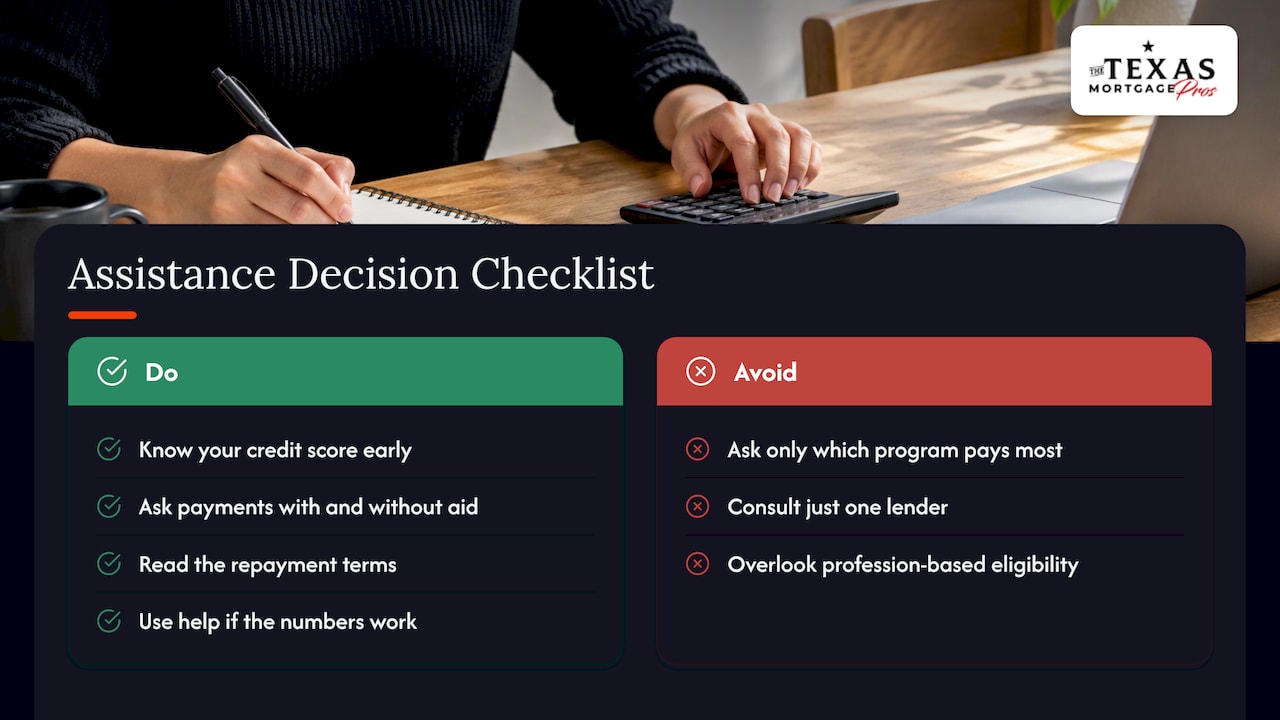
Most buyers who ask us about assistance ask the wrong first question. They ask which program gives the most money. We think the better question is which combination of loan and assistance costs the least for the years you will own the home.
Because we are a brokerage with access to more than 70 lenders, we can look at that question across more than one lender’s pricing. Not every lender participates in every Texas program, and a buyer who talks to only one may never hear about the others. We have also seen that veterans, teachers, and first responders sometimes miss that they may qualify through a profession-based program. A VA loan can sometimes make more sense than assistance on another loan type, so we check that too.
Our advice is simple. Know your credit score early. Ask for the payment with and without assistance. Read the repayment terms for the form you choose. If the numbers work, use the help. If they do not, say so and look at other options.
— Michelle
Getting matched with the right program
We help Texas buyers compare assistance programs alongside the loan, from pre-qualification to closing. If you are a first-time buyer, a veteran, or a repeat buyer who wants to know what you qualify for, start with our first-time homebuyer and down payment assistance options. If you are weighing loan types, see our FHA, VA, USDA, and conventional loans.

Get pre-qualified today, and we will tell you which programs fit your credit, income, and county.
FAQ
Does TSAHC down payment assistance have to be repaid?
It depends on the form. The grant is not repaid if the first mortgage is not refinanced or paid off in the first six months. The three-year forgivable lien is forgiven on the third anniversary, but you must repay it if you sell, refinance, or transfer the home earlier. A deferred repayable lien is repaid when you sell, transfer, pay off, or refinance the first mortgage.
Do I have to be a first-time buyer to use TSAHC?
No, Home Sweet Texas is open to first-time and repeat buyers who meet income limits. First-time buyers may also apply for a Mortgage Credit Certificate. Homes for Texas Heroes is limited to the eligible professions TSAHC lists.
What credit score do I need?
TSAHC’s September 2026 guidelines set a minimum FICO of 620 for government loans and 640 for HFA conventional loans. SETH requires 640. Individual lenders can set higher minimums, so ask yours.
What is the difference between TSAHC, TDHCA and SETH?
All three offer up to 5% of the loan amount through participating lenders. TSAHC and TDHCA are Texas housing agencies with their own loan programs, and SETH runs the 5 Star Texas program. They differ in assistance forms, first-time buyer rules, credit minimums, and where they apply, so have a lender compare them for your situation.
What is the biggest negative of down payment assistance?
The usual one is the cost over time. The first mortgage, paired with the assistance, can carry a higher rate, and you may need to repay a lien if you sell or refinance early. Compare the full monthly payment and how long you’ll likely stay in the home before you decide.
Sources
- Loans and Down Payment Assistance, Texas State Affordable Housing Corporation
- Home Sweet Texas, TSAHC
- Guidelines for Down Payment Assistance (Bond and Non-Bond), TSAHC
- Do I have to pay back the down payment assistance provided by TSAHC?
- Become an Approved Lender, TSAHC
- Programs, The Texas Homebuyers Program (TDHCA)
- Lender Guide, TDHCA
- SETH 5 Star Texas Homebuyer Assistance Program