
Most borrowers qualify for an FHA loan with a 580 FICO score and 3.5% down, though many lenders set the practical floor closer to 620 through their own overlays. Debt payments generally cannot exceed a common guideline percentage of gross income, but automated underwriting frequently pushes that ceiling higher for well-documented borrowers, thanks to this AI for lenders. Everything else, property condition, loan limits, employment history, determines whether that baseline actually holds up.
TL;DR:
- Most lenders overlay stricter credit score requirements, making it difficult to get approved at scores below 580 despite FHA’s minimal cutoff of 500.
- Borrowers with credit scores between 560 and 575 should focus on reducing credit card utilization for 60 to 90 days to improve chances of qualifying.
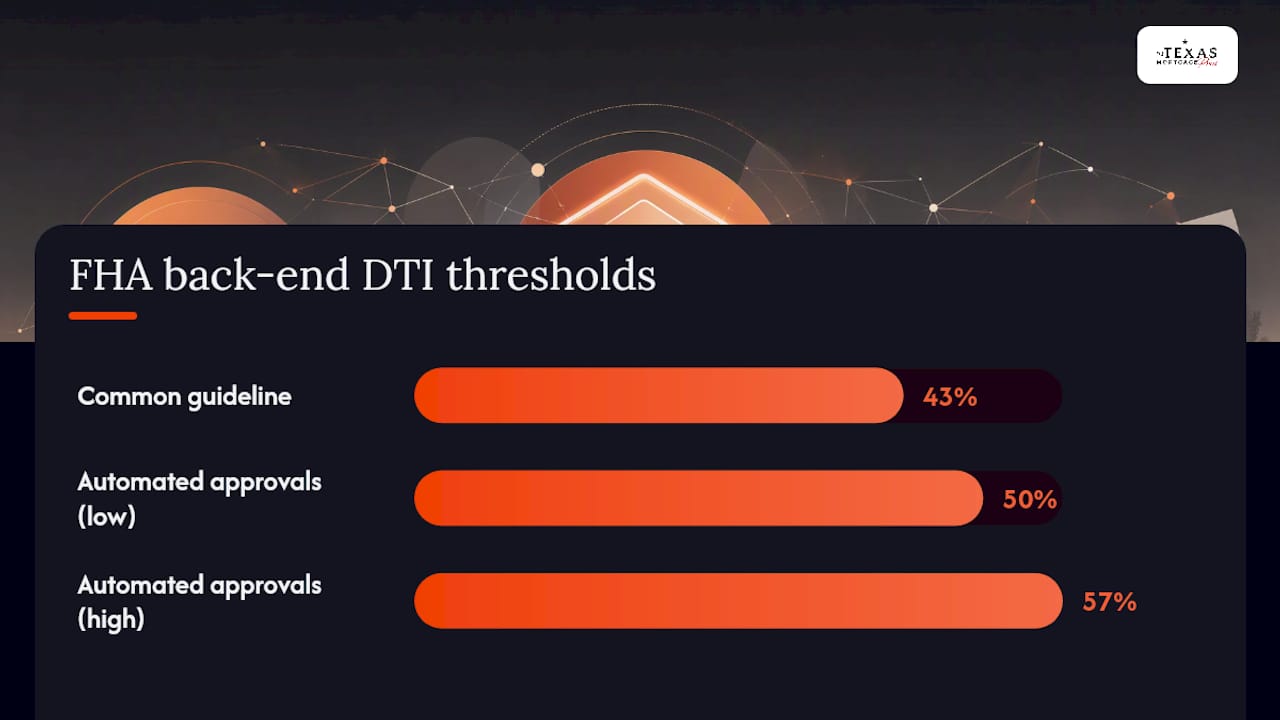
- FHA allows up to approximately 43% back-end debt-to-income ratio, but approvals up to 50-57% are possible with strong compensating factors.
- Property issues like peeling paint or water damage can be remedied before closing or financed through FHA’s renovation loan; automatic dealbreakers are uncommon.
- FHA limits vary by county, so borrowers must verify local loan caps and consider alternative financing if their desired home’s price exceeds FHA limits.
Table of Contents
- FHA Loan Requirements Checklist: What to Verify Before You Apply
- Credit Score Tiers and Down Payment Rules
- Income Documentation and Debt-to-Income Limits
- FHA Property Standards: What Can Fail Your Appraisal
- FHA Loan Limits by County: How Much You Can Actually Borrow
- How to Apply for an FHA Loan: Step by Step
- Common Reasons FHA Applications Get Denied
- How The Texas Mortgage Pros Helps You Navigate FHA Approval
- FHA Streamline Refinance and Cash-Out Refinance Eligibility
- Citizenship and Residency Rules for FHA Borrowers
- Why the 580 Credit Score Number Gets Oversold
- Get Pre-Qualified for an FHA Loan With The Texas Mortgage Pros
- Sources
FHA Loan Requirements Checklist: What to Verify Before You Apply
Before you call a lender, run through this list. It mirrors what underwriters check first, and catching a problem now saves you a denial letter later.
- Residency and Social Security number. You need a valid SSN and eligible residency status, and the home must become your primary residence within 60 days of closing.
- Two-year employment history. Job hopping isn’t disqualifying, but gaps need explanations, and the same field of work helps your case.
- Credit score tier. 580+ opens the door to 3.5% down; scores between 500 and 579 require 10% down.
- Debt-to-income snapshot. Add up your monthly debts against gross income; FHA mortgage guidelines generally cap this around 43%, with room to negotiate if your file is strong elsewhere.
- Property type and price. Confirm the home qualifies as a primary residence and falls under your county’s FHA loan limit.
Lenders build their underwriting around Handbook 4000.1, the FHA’s master policy manual. It’s dense reading, but it’s the reason two lenders can quote you different answers to the same question; each is applying baseline HUD policy plus its own overlay.
Credit Score Tiers and Down Payment Rules
Here’s the number that trips people up: FHA technically allows a 500 FICO score, but almost no lender will actually approve you at that level. The 500 to 579 band exists on paper, and it requires 10% down instead of 3.5%, but overlays, a lender’s internal risk rules stacked on top of FHA minimums, mean most brokers won’t originate below 580. That’s not FHA being strict. That’s individual lenders protecting themselves from having to buy back loans if borrowers default early.
The realistic path looks like this:
- 580 and above unlocks the 3.5% down payment most people associate with FHA loans.
- 500 to 579 technically qualifies you, but expect a 10% down payment requirement and a smaller pool of willing lenders.
- Below 500 disqualifies you from FHA financing entirely, regardless of down payment size.
Your down payment doesn’t have to come entirely from savings. Acceptable sources include gift funds from family (with a signed gift letter), down payment assistance programs, employer assistance, and grants, provided that each source is documented with a paper trail showing the origin of the funds. Undocumented cash deposits are one of the fastest ways to stall underwriting.
Pro Tip: If your score is between 560 and 575, spend 60 to 90 days paying down revolving credit card balances before applying. A lower utilization ratio can push you over the 580 line and cut your down payment requirement by more than half.
Adding a co-borrower with stronger credit or lower debt can also help you clear both the credit and DTI hurdles at once, especially useful for first-time buyers pairing up with a parent or spouse.
Income Documentation and Debt-to-Income Limits
Lenders need proof that your income is stable, not just sufficient. Standard documentation includes:
- Two most recent pay stubs
- W2s or 1099s from the past two years
- Two years of federal tax returns if you’re self-employed or commission-based
- Two to three months of bank statements
- A verbal or written verification of employment near closing
Debt-to-income math runs on two tracks. Front-end DTI measures your proposed housing payment as a percentage of your gross monthly income. Back-end DTI adds every other debt, credit cards, car payments, and student loans, into that same equation. The Consumer Financial Protection Bureau notes that FHA loans allow more flexible treatment of credit and DTI than conventional financing, which is why FHA remains the go-to program for buyers with imperfect financial histories.
The commonly cited back-end ceiling sits at 43%, but that’s a starting point, not a hard wall. Industry guidance on FHA DTI ratios shows automated underwriting can approve back-end ratios as high as 50% to 57% when compensating factors are strong, meaning significant cash reserves, minimal new debt, or residual income well above your area’s median.
Self-employed borrowers face extra scrutiny since income can swing year to year; expect lenders to average two years of tax returns rather than count your best month. Student loans in deferment aren’t ignored either; FHA guidelines require lenders to calculate an estimated payment even when nothing is currently due.
FHA Property Standards: What Can Fail Your Appraisal
FHA doesn’t just underwrite you; it underwrites the house. HUD’s Minimum Property Standards require homes to meet safety, security, and durability benchmarks that go beyond standard local building codes. The logic is straightforward: HUD is insuring the loan, so it wants the collateral to hold its value.
Appraisers flag issues most buyers never think to check:
- Peeling or chipping paint, especially on homes built before 1978
- Missing handrails on stairs or elevated porches
- Broken windows or non-functioning HVAC systems
- Damaged gutters and downspouts that could lead to water intrusion
- Exposed wiring or evidence of active roof leaks
None of these are automatic dealbreakers. Sellers often agree to repairs before closing, or the lender can escrow funds to cover the fix after the sale. For homes needing more extensive rehabilitation, an FHA 203(k) renovation loan rolls repair costs into the mortgage, which is useful for buyers eyeing a fixer-upper that wouldn’t otherwise pass appraisal.
Pro Tip: Ask your agent to request the seller’s disclosure and any prior inspection reports before you order the FHA appraisal. Fixing a known issue in advance is cheaper than renegotiating after a failed inspection.
FHA Loan Limits by County: How Much You Can Actually Borrow
FHA sets a national “floor” and “ceiling” for loan amounts, and your county’s limit falls somewhere between the two based on local home prices. High-cost markets, think parts of California or the Northeast, get the ceiling; most of the country sits closer to the floor.
HUD’s 2026 nationwide loan limit guidance updates these figures annually to track home price movement, and special exception areas like Alaska, Hawaii, and parts of the U.S. territories get adjusted ceilings above the standard cap.
- Check your exact county limit using HUD’s loan limit lookup tool before you start shopping for homes.
- If the home you want exceeds your county’s limit, you’ll need a conventional or jumbo loan instead; FHA financing won’t cover the gap.
- Limits apply per unit, so a duplex or fourplex has a higher combined ceiling than a single-family home.
How to Apply for an FHA Loan: Step by Step
- Get pre-qualified. A lender reviews your income, credit, and debts to estimate how much you can borrow, usually within a day or two.
- Gather documentation. Pull together pay stubs, tax returns, and bank statements before you make an offer; our mortgage application document checklist walks through exactly what’s needed.
- Submit a formal application. Once you’re under contract, your file moves to full underwriting, typically two to four weeks depending on lender volume.
- Order the appraisal. FHA requires an FHA-approved appraiser, not just any licensed appraiser, to confirm the home meets minimum property standards.
- Clear conditions and close. Underwriters may request additional documents; respond quickly to avoid delaying your closing date.
Shopping multiple FHA-approved lenders matters because overlays vary widely; one lender’s “no” can be another lender’s approved file with the exact same credit and income profile.
Common Reasons FHA Applications Get Denied
Most denials trace back to a handful of fixable issues:
- Undocumented deposits. Large, unexplained bank deposits raise red flags; document every transfer with a paper trail.
- DTI creeping above guidelines. Paying down a credit card or car loan before applying can bring your ratio back into range.
- Appraisal failures. Repairs, seller concessions, or a switch to a 203(k) loan can resolve most property-condition denials.
- Insufficient credit history. Borrowers with thin credit files may need a manual underwrite rather than automated approval through the TOTAL Mortgage Scorecard.
When a file gets an automatic “refer” instead of “approve,” a broker can often request manual underwriting and build a case using compensating factors the algorithm missed.
How The Texas Mortgage Pros Helps You Navigate FHA Approval
Every lender interprets FHA mortgage guidelines a little differently, which is exactly why working with a broker who shops across a network matters. The Texas Mortgage Pros compares offers from more than 70 lenders, so a credit score or DTI ratio that gets rejected at one shop might sail through at another with zero changes to your file.
- First-time buyers get help translating FHA eligibility criteria into a real action plan.
- Veterans and borrowers with nonstandard income get guidance on which lenders are more flexible with overlays.
- Anyone facing a denial gets a second look at whether manual underwriting or a different lender changes the outcome.
If your situation involves self-employment income, a recent credit event, or a property that needs repair work, that’s when broker support pays for itself. Explore FHA loan options in Texas to see how the process fits your specific numbers.
FHA Streamline Refinance and Cash-Out Refinance Eligibility
Refinancing an existing FHA loan comes with its own rulebook, and it’s more forgiving than a purchase transaction. The FHA Streamline Refinance skips the appraisal in most cases and requires minimal documentation, provided you’re refinancing an existing FHA loan into a lower rate and can show a net tangible benefit, typically a reduced monthly payment. Credit checks are often waived entirely for streamline refinances, though individual lenders may still pull credit as an overlay.
Cash-out refinancing works differently. You’ll need to qualify much like a new purchase: a full appraisal, income documentation, and a credit check. Debt-to-income limits apply the same way they do for a purchase loan, and any liens or judgments against the property must be resolved before closing.
One overlooked detail: you don’t need an existing FHA loan to do an FHA cash-out refinance. Homeowners with conventional mortgages can refinance into FHA financing to access equity, though they’ll pay FHA’s mortgage insurance premium, both upfront and annually, which changes the long-term cost math. Run the numbers before assuming cash-out is cheaper than a home equity line just because the rate looks lower.
Citizenship and Residency Rules for FHA Borrowers
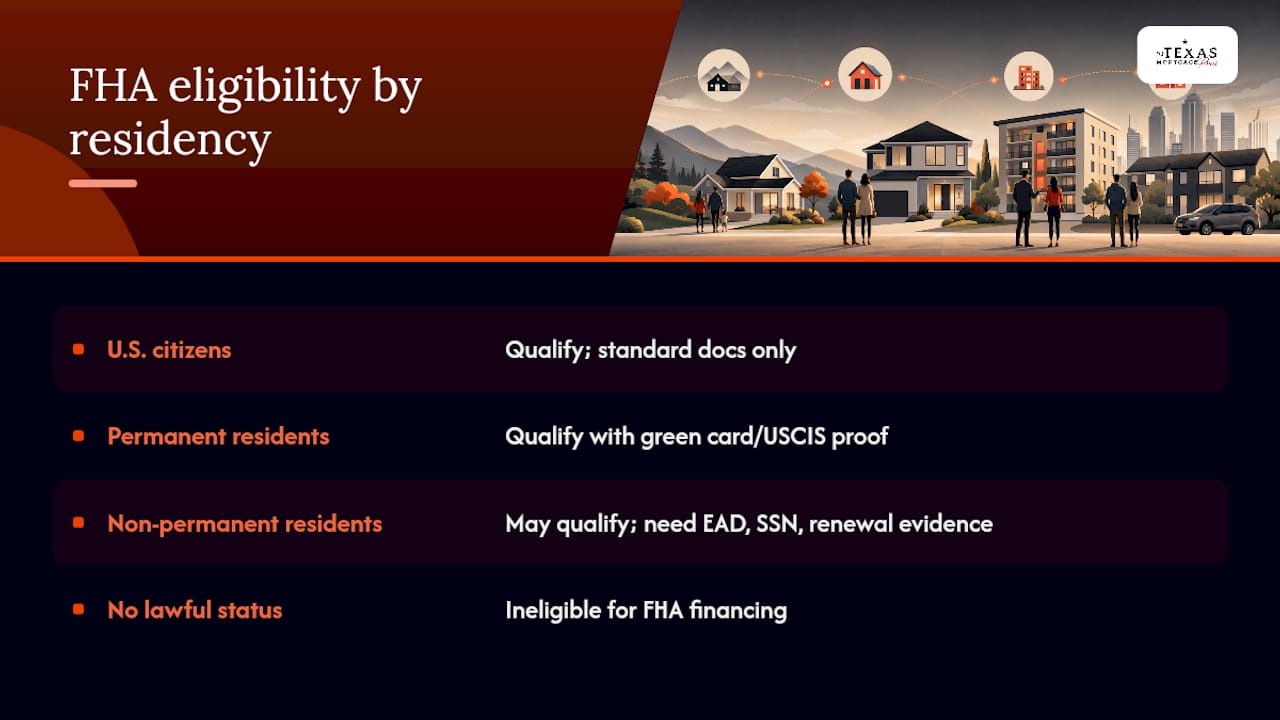
FHA loans are open to a wider range of residency statuses than many buyers assume. U.S. citizens qualify without additional documentation beyond standard income and credit verification. Permanent residents (green card holders) qualify under the same terms as citizens, provided they can document their status with their physical card or equivalent USCIS documentation.
Non-permanent residents, such as work visa holders, can also qualify, but the requirements get more specific. Lenders typically require evidence of an Employment Authorization Document, a valid Social Security number, and a reasonable likelihood that the visa will be renewed or that the borrower will maintain legal residency for the foreseeable future. A visa expiring within a year of closing can complicate approval unless there’s clear evidence of renewal.
What FHA does not allow: borrowers with no lawful residency status in the U.S. cannot obtain FHA financing, regardless of income or credit strength. This is one area where lender overlays vary the least, since it’s a program eligibility rule rather than a risk-based decision.
If your status falls into a gray area, seasonal work visas, recent green card approval, or pending asylum cases, get documentation together early. These files take longer to underwrite, and a broker who’s seen similar cases before can flag which lenders are equipped to handle them without unnecessary delay.
Why the 580 Credit Score Number Gets Oversold
The most repeated fact about FHA loans, that a 580 credit score unlocks a 3.5% down payment, is technically true and practically misleading. It’s the ceiling of what’s possible, not the floor of what’s likely. The gap between “FHA allows this” and “your local lender will actually do this” is where most borrower frustration comes from, and almost no generic guide addresses it honestly.
The conventional advice tells you to check your credit score and stop there. The better advice tells you to check your score, then ask a broker how that score performs across a dozen different lenders, because overlays vary that much. A 600 FICO score with a clean 12-month payment history and modest debt can outperform a 640 score carrying high credit card utilization, even though the raw number looks worse on paper.
If you take one thing from this article, it’s this: don’t self-select out of FHA financing based on a number you read online. Get your actual file in front of someone who works with multiple lenders daily, because the FHA mortgage guidelines on paper and the FHA loans that actually close are two different documents. Property condition and documented income consistency tend to matter more than most buyers expect when they go in.
— Michelle
Get Pre-Qualified for an FHA Loan With The Texas Mortgage Pros
Reading the rules is one thing. Finding out which lender will actually approve your specific file is another, and that’s the gap The Texas Mortgage Pros exists to close. Instead of applying with one bank and hoping their overlay matches your profile, you get access to a network of more than 70 lenders comparing offers on your behalf, so a denial at one shop doesn’t end your homebuying plans.

This matters most if your situation doesn’t fit neatly into a textbook file: self-employment income, a recent credit event, a property needing repairs, or a visa status requiring extra documentation. First-time buyers and veterans get the same broker-led attention, with guidance from pre-qualification through closing rather than a call center reading from a script.
Start by running your numbers through our mortgage calculators to see what a 3.5% down payment looks like for your target price range, then reach out to get pre-qualified and see which lenders in our network best fit your file.
This article is general information, not a substitute for advice from a qualified financial advisor. Consult a qualified financial professional about your own circumstances before acting on anything here.