
If you’re a resident, fellow, or new attending physician, this loan type is very likely to help you. Physician loans typically offer low or no down payment, no borrower-paid PMI, and flexible treatment of student loan debt, and many lenders will accept a signed employment contract in place of paystubs. Here’s what you need to know at a glance:
- Low or no down payment: Most programs allow 0%–5% down without requiring PMI.
- No borrower-paid PMI: Even below 20% equity, you won’t pay private mortgage insurance.
- Flexible student-loan DTI: Lenders often count your actual income-driven repayment (IDR) payment rather than 1% of your total balance.
- Contract-based qualifying: A signed offer letter or residency contract can substitute for paystubs.
The immediate next step is to get prequalified. Contact The Texas Mortgage Pros for a tailored rate quote and lender match across a network of 70+ physician-program lenders.
Key Takeaways
| Point | Details |
|---|---|
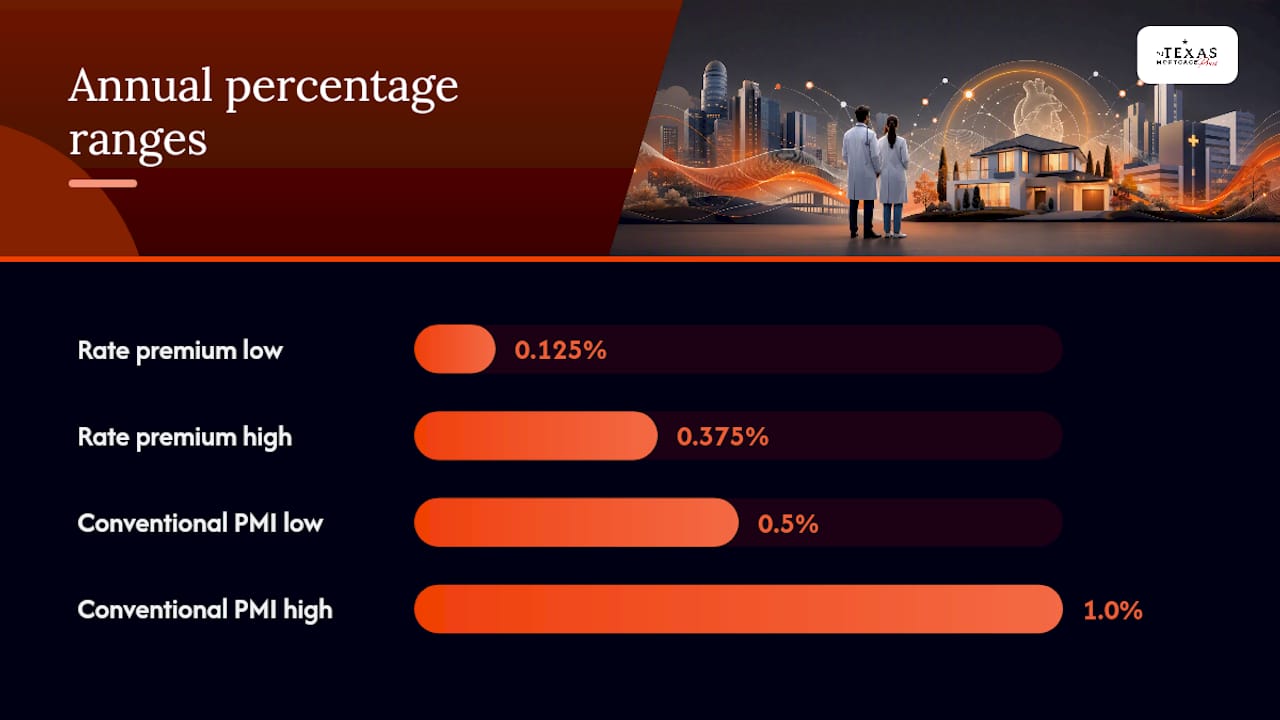
| PMI savings usually win | The 0.125%–0.375% rate premium is typically less than the 0.5%–1.0% annual PMI cost on a low-down conventional loan. |
| Residents qualify too | Lenders accept signed contracts with a start date within 60–90 days of closing, so residents can buy before their first paycheck. |
| Student loans treated fairly | Actual IDR/IBR payments count toward DTI, not 1% of balance, which can add tens of thousands in qualifying power. |
| Shop multiple lenders | Rate spreads across physician lenders vary by 0.25%–0.50%, making lender comparison one of the highest-value steps you can take. |
| The Texas Mortgage Pros | Matches Texas physicians to the right physician program across 70+ lenders; get a personalized rate quote before you apply. |
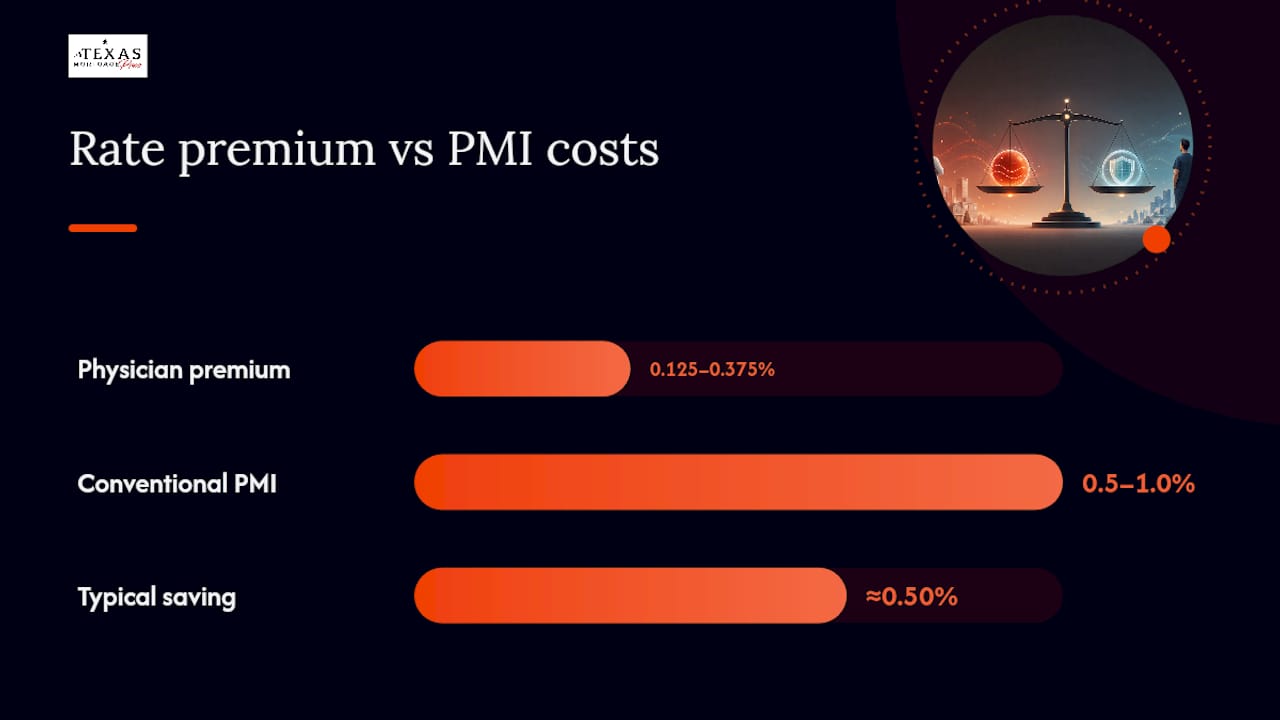
Table of Contents
- What does a physician mortgage program actually offer?
- Who qualifies for a physician mortgage?
- How does physician mortgage underwriting actually work?
- Pros and cons: when does a physician mortgage make sense?
- How do physician mortgages compare to conventional, FHA, VA, and jumbo loans?
- What documents do you need and how does the application process work?
- What does a physician mortgage actually cost?
- How a broker helped a physician close on time
- What most physicians get wrong about this decision
- The Texas Mortgage Pros physician mortgage program
- Sources
What does a physician mortgage program actually offer?
Physician mortgage programs share a consistent set of features across most lenders, though the exact terms vary. Understanding the standard package helps you evaluate any offer quickly and spot programs that fall short.
Core program features:
- 0% to 5% down payment on primary residences, with 0% down commonly available up to $750,000–$1,000,000 depending on the lender.
- No borrower-paid PMI, even when your loan-to-value ratio exceeds 80%.
- Higher loan limits than the conforming limit. Physician loan limits commonly start at $1 million for low-down programs, and some lenders extend to $3.5 million or more for borrowers with larger down payments.
- Flexible DTI treatment for student loans, typically using your actual IDR or IBR payment rather than the standard 1%-of-balance convention.
- Contract-based income verification, allowing residents and new attendings to qualify before their first paycheck.
Common trade-offs to expect:
- A modest rate premium, typically around 0.125%–0.375% above a comparable conventional rate.
- Portfolio underwriting, meaning the lender holds the loan on its own books and sets its own rules.
- Primary-residence-only restriction in virtually all programs.
Statistic callout: The typical physician-mortgage rate premium runs 0.125%–0.375%, while PMI on a low-down conventional loan commonly costs 0.5%–1.0% of the loan balance annually. For most physicians buying with less than 20% down, eliminating PMI saves more per month than the rate premium costs.
Pro Tip: Run the numbers before assuming a conventional loan is cheaper. A physician mortgage’s rate premium on the same balance typically adds far less.
Who qualifies for a physician mortgage?
Eligibility is broader than many physicians expect. Most programs cover MD, DO, DDS, and DMD designations. Many lenders also extend coverage to DPM (podiatrists), PharmD, and certain advanced practice providers, though that varies by lender. Residents and fellows are explicitly included in most programs, not just attending physicians.
Typical credit and DTI expectations
Lenders generally look for a credit score of 700 or above, though some programs accept scores as low as 680. DTI (debt-to-income ratio) flexibility is one of the program’s strongest features.
Eligibility matrix: resident vs. attending
| Qualifying Factor | Resident / Fellow | New Attending |
|---|---|---|
| Income documentation | Signed residency contract or offer letter | Signed attending contract; paystubs if available |
| Employment start window | Contract start within 60–90 days of closing | Typically within 90 days of closing |
| Student loan treatment | Actual IDR/IBR payment or $0 if deferred | Actual IDR/IBR payment |
| Minimum credit score | 700 (some lenders 680) | 700 (some lenders 680) |
| Down payment required | 0%–5% depending on loan amount | 0%–5% depending on loan amount |
| Loan limit (0% down) | Up to $750K–$1M (lender-specific) | Up to $750K–$1M (lender-specific) |
Documents lenders typically require
- Medical degree or professional license (or proof of enrollment in final year)
- Signed residency contract, fellowship contract, or attending employment offer letter
- Student loan statements showing current monthly payment or deferment status
- Two to three months of bank statements
- Government-issued photo ID
- Authorization for credit pull
- Federal tax returns (usually two years, though some lenders waive this for residents)
Pro Tip: If your student loans are on an income-driven plan, pull your current IDR payment confirmation from your servicer before you apply. Showing the actual payment upfront prevents underwriting delays.
How does physician mortgage underwriting actually work?
The mechanics behind a physician mortgage differ from a conventional loan in three meaningful ways: who holds the loan, how income is verified, and how student debt is counted.
Portfolio lending explained
Conventional mortgages are typically sold to Fannie Mae or Freddie Mac after closing, which means lenders must follow agency guidelines. Physician mortgages are portfolio products. The lender keeps the loan on its own balance sheet and writes its own rules.
How a signed contract replaces paystubs
When you’re a resident starting in July or a new attending who signed an offer letter in April, you have no paystubs yet. Lenders often require the contract start date to be within 60–90 days of closing to underwrite on future income. The contract must show your base salary, start date, and employer. Some lenders also want a non-revocation letter confirming the offer is still active.
Student-loan DTI treatment approaches
Lenders handle student loan debt in one of three ways:
- Actual IDR/IBR payment: The most favorable approach. If your monthly payment is $200 on a $300,000 balance, only $200 counts toward your DTI.
- Exclude deferred loans entirely: Some programs exclude loans in deferment from DTI calculations altogether.
- Reduced-payment assumption: A few lenders apply a percentage lower than the standard 1%-of-balance rule, such as 0.5%, as a compromise.
The underwriting flow, step by step
- Prequalification: Provide income, debt, and credit overview. Get a ballpark loan amount and program fit.
- Preapproval: Submit full documents (contract, ID, bank statements, student loan statements). Lender issues a conditional approval letter.
- Property search and purchase contract: Use your preapproval letter to make competitive offers.
- Full underwriting submission: Lender orders appraisal, title, and verifies all documents. Physician-specific flex points (contract income, student loan treatment) are confirmed here.
- Clear to close: All conditions satisfied. Final loan disclosure issued.
- Closing: Sign documents, fund the loan, receive keys.
The physician-specific flexibility appears most at steps 2 and 4, where the lender confirms contract-based income and applies its student-loan DTI policy.
Pros and cons: when does a physician mortgage make sense?
A doctor home loan is not automatically the right choice for every physician. The decision depends on your down payment, student debt load, and how soon you need to close.
Pros:
- Buy sooner with limited cash reserves, preserving savings for student loan payoff or an emergency fund.
- No PMI, which removes a cost that would otherwise persist until you reach 20% equity.
- Flexible DTI for student loans, which can make the difference between qualifying and not.
- Qualify on a signed contract before your first paycheck arrives.
Cons:
- Interest rates run slightly higher than conventional loans, which adds cost over the life of the loan.
- Taking 0% down means a larger loan balance and more interest paid overall.
- Portfolio products mean lender availability varies by state and market.
- Primary-residence-only restriction rules out investment properties and second homes.
If you have 20% or more saved and carry low student debt, a conventional loan often costs less over time.
Pro Tip: Don’t overlook the opportunity cost of tying up $80,000–$120,000 in a down payment. Many early-career physicians are better served keeping that cash liquid and using a physician mortgage instead.
How do physician mortgages compare to conventional, FHA, VA, and jumbo loans?
Each loan type serves a different borrower profile. Here’s how the options stack up on the factors that matter most to physicians.
| Feature | Physician Mortgage | Conventional | FHA | VA |
|---|---|---|---|---|
| Minimum down payment | 0%–5% | 3%–20% | 3.5% | 0% |
| PMI required | No | Yes (under 20%) | Yes (MIP, life of loan) | No |
| Student loan DTI | Actual IDR/IBR payment | 1% of balance (often) | 1% of balance | Actual payment |
| Income documentation | Contract accepted | Two-year history | Two-year history | Two-year history |
| Loan limits | Up to $1M–$3.5M | Conforming limit (~$800,000) | FHA limit (county-specific) | No set limit |
| Who it’s for | MD, DO, DDS, DMD, others | Any qualified borrower | Lower credit/down payment | Eligible veterans |
Use-case examples:
- Resident buying locally on a training salary: A physician mortgage is the clear choice. The contract-based qualifying and student-loan DTI flexibility are built for this exact situation.
- Fourth-year resident with an attending contract: Start the preapproval process 90–120 days before training ends. A physician mortgage lets you close on the attending salary before your first paycheck.
- First-year attending in a high-cost market: Physician programs with limits up to $1M–$3.5M handle jumbo-range purchases without the stricter reserves and documentation requirements of a standard jumbo loan.
When FHA or VA actually wins:
FHA can be the better call when your credit score falls below 680 and you don’t yet have the history to qualify for a physician program. If you served, use your VA benefit first. See how FHA and conventional loans compare for more context on those trade-offs.
Because physician mortgages are portfolio products, rate spreads among physician lenders commonly vary by 0.25%–0.50%. Getting three to five quotes is not optional — it’s the single most effective cost-control step you can take.
What documents do you need and how does the application process work?
Gathering your documents before you start shopping saves weeks. Here’s the complete checklist and a realistic timeline.
Complete documents checklist:
- Medical degree, professional license, or proof of enrollment in final year of training
- Signed residency, fellowship, or attending employment contract (showing base salary and start date)
- Student loan statements (all servicers, showing current monthly payment or deferment status)
- Two to three months of bank and investment account statements
- Government-issued photo ID
- Social Security number for credit authorization
- Federal tax returns for the past two years (some lenders waive for residents)
- Most recent paystubs if you are currently employed
For a broader look at what lenders request, the mortgage application documents guide covers the full standard checklist.
Step-by-step application timeline
- Days 1–7: Gather all documents above. Pull your credit report at AnnualCreditReport.com and dispute any errors.
- Days 7–14: Submit preapproval applications to three to five physician-program lenders. Compare loan estimates side by side.
- Days 14–21: Receive preapproval letters. Begin property search with a real estate agent.
- Days 21–45: Make an offer and execute a purchase contract. Notify your lender immediately.
- Days 45–55: Lender orders appraisal and title work. Submit any outstanding documents.
- Days 55–65: Underwriting review. Respond to conditions promptly to avoid delays.
- Days 65–75: Clear to close. Review Closing Disclosure at least three business days before closing.
- Day 75–90: Closing day. Sign, fund, and receive keys.
Resident-specific timing note: Most lenders require your contract start date to be within 60–90 days of closing. If you’re a fourth-year resident, begin the preapproval process roughly 90–120 days before your training ends. That window gives you time to shop lenders, find a property, and close before your attending contract begins.
Pro Tip: Understand the difference between prequalification and preapproval before you start. Prequalification is a quick estimate based on self-reported data. Preapproval involves a hard credit pull and document review — it’s what sellers and agents take seriously. For a detailed walkthrough, the mortgage pre-approval guide is a practical starting point.
What does a physician mortgage actually cost?
Understanding the real monthly and lifetime cost of a physician mortgage requires comparing it directly to the conventional alternative with PMI.
Rate premium vs. PMI: a sample calculation
The physician mortgage costs roughly $109 more per month in interest but saves $416 in PMI, for a net monthly savings of about $307.
Some lenders offer lender credits to reduce out-of-pocket costs at closing in exchange for a slightly higher rate. Use the mortgage calculators to model your specific loan amount, rate, and PMI scenario before committing to a program.
Other cost notes:
- No origination fee programs exist but usually carry a higher rate.
- Appraisal fees, title insurance, and prepaid escrow items apply regardless of loan type.
- Bankrate notes that physician mortgage rates are sometimes slightly higher than conventional rates, reinforcing the importance of shopping multiple lenders.
Statistic callout: Rate spreads across physician lenders can vary by 0.25%–0.50%. On a $665,000 loan, a 0.25% rate difference equals roughly $100 per month and more than $36,000 over a 30-year term.
How a broker helped a physician close on time
Consider a scenario that plays out regularly in physician mortgage transactions. A third-year internal medicine resident in Houston signed an attending contract in March with a July 1 start date. She had $280,000 in student loans on an IBR plan with a $190 monthly payment, $45,000 in savings, and a 718 credit score.
The broker’s role in that transaction was to identify which of the available physician programs would treat the IBR payment favorably and close within the required window. That lender-matching function is where broker access to 70+ lenders creates real, measurable value.
You can verify the licensing and registration of any lender or broker at Nmlsconsumeraccess. All loans are subject to credit approval and lender-specific underwriting guidelines.
Pro Tip: *When you have complex student loan arrangements, tell your broker upfront.
What most physicians get wrong about this decision
The conventional wisdom says physician mortgages are always the right call for doctors. That’s an oversimplification that costs some physicians money.
The other mistake is treating the physician mortgage as a permanent solution. The physician mortgage gets you into the home. The refinance optimizes the long-term cost.
What we consistently see at The Texas Mortgage Pros is that physicians who shop three to five lenders and run the actual PMI-versus-rate-premium math make better decisions than those who take the first physician program they’re offered. The specialty products page covers additional options for physicians with non-standard situations, including non-QM programs for those whose income structure doesn’t fit even a physician program’s guidelines.
The Texas Mortgage Pros physician mortgage program
Physicians and residents in Texas have a specific advantage working with The Texas Mortgage Pros: access to physician mortgage programs across a network of 70+ lenders, all in one place. Rather than applying to five lenders separately and managing five separate credit pulls and timelines, you get a single point of contact who knows which lenders treat IBR payments favorably, which ones close within a 60-day contract window, and which programs offer the most competitive rates for your loan amount.

The Texas Mortgage Pros handles physician mortgage programs, contract-window closings for residents and fellows, and lender shopping across the full physician-program market in Texas. Before your consultation, run your numbers with the mortgage calculators to get a baseline monthly payment estimate. Then get a personalized rate quote tailored to your loan amount, credit profile, and timeline.
The Texas Mortgage Pros is a licensed Texas mortgage broker. All loans are subject to credit approval and lender-specific underwriting guidelines. To verify licensing, visit nmlsconsumeraccess.org. For physicians who also qualify as first-time buyers, first-time homebuyer programs may offer additional down payment assistance options worth exploring alongside a physician program.
Sources
- Physician Mortgage vs. Conventional Loan (2026)
- The Complete Physician Mortgage Guide (2026): 0% Down, No PMI, and the Lender That’s Right for You
- Doctor Mortgage Loan Complete Guide | The White Coat Investor
- Physician Mortgage Loans Guide
This article is for general informational purposes only and does not constitute financial, legal, or mortgage advice. Loan terms, rates, and eligibility requirements vary by lender and are subject to change. Confirm current program details and your specific eligibility with a licensed mortgage professional.
This article is general information, not a substitute for advice from a qualified financial advisor. Consult a qualified financial professional about your own circumstances before acting on anything here.