Filing homestead exemption in Texas means submitting Form 50-114 (Application for Residence Homestead Exemption) to the appraisal district for the county where your home sits. It costs nothing to file. Most counties now accept the form online, and your Texas driver’s license address usually has to match the property address before an appraisal district will approve it.
- File before May 1 for on-time processing that tax year.
- Missed the date? You can often still file, with limited backdating available.
- Free to submit. Never pay a third-party site for this paperwork.
Key Takeaways
Filing homestead exemption in Texas requires submitting Form 50-114 to your county appraisal district by May 1, free of charge, with a Texas ID that matches your property address.
| Point | Details |
|---|---|
| Use the right form | Form 50-114 covers most homeowners; Form 50-114-A applies when you lack a standard deed. |
| Match your ID address | Your Texas driver’s license must show the property address, or your application can stall. |
| File with your county | Submit to the appraisal district covering the property, such as HCAD, Tarrant Appraisal District, or Travis CAD. |
| Hit the May 1 deadline | Late filing may still qualify for limited retroactive approval, so contact your district if you miss it. |
| Plan your finances further | The Texas Mortgage Pros’ mortgage calculators help you see how tax savings affect your overall monthly payment. |
Table of Contents
- How to File a Homestead Exemption in Texas: Step by Step
- Who Qualifies for the General Residence Homestead Exemption?
- Which Forms and Documents Do You Need?
- Where and How Do You File Your Application?
- What’s the Deadline and How Long Does Approval Take?
- What Special Exemptions and Edge Cases Should You Know?
- What Mistakes Cause Filing Delays or Denials?
- Why Filing Early Protects More Than Your Tax Bill
- Get Help Planning Beyond Your Property Tax Savings
- Official Forms and County Pages Worth Bookmarking
- Sources
How to File a Homestead Exemption in Texas: Step by Step
Getting this done takes less time than most homeowners expect. Follow these steps in order and you will avoid the delays that trip up first-time filers.
- Confirm eligibility first. You need ownership interest in the home and it has to be your principal residence as of January 1.
- Pull the correct form. Download Form 50-114 directly from the Comptroller’s site or your county appraisal district’s homestead page.
- Gather your documents. You’ll need a Texas driver’s license or state ID showing the property address, plus a copy of your deed if the district requests it.
- Identify your county appraisal district. Harris County homeowners file with Harris Central Appraisal District (HCAD); Tarrant County residents use Tarrant Appraisal District; Travis County owners file with Travis Central Appraisal District.
- Submit the application. Use your county’s online portal or mobile app, mail it in, fax it, or drop it off in person, whichever your specific district supports.
- Save your confirmation. Keep a screenshot, email receipt, or mailing tracking number as proof you filed on time.
- Check back for approval. Log into your appraisal district account or watch for your Notice of Appraised Value.
Pro Tip: If your driver’s license still lists your old address, don’t wait to fix it before filing. Contact your appraisal district directly. Many have a process for handling the mismatch so your application isn’t delayed while you update your ID.
Who Qualifies for the General Residence Homestead Exemption?
The rules are more forgiving than most homeowners assume, but three requirements are non-negotiable.
- You must hold an ownership interest in the property.
- The home must be your principal residence as of January 1 of the tax year.
- You cannot claim a homestead exemption on any other property, in Texas or elsewhere.
- Residential acreage is generally capped at 20 acres for the exemption to apply.
Partial owners, mobile homeowners with proper titling, and people who inherited a house without a deed in their name can typically still qualify, though the paperwork looks a little different (more on that below).
Here’s the number that matters most: Texas school districts must grant a $140,000 exemption off your home’s taxable value under Tax Code Section 11.13(b), and cities, counties, or special districts can layer on their own local-option exemptions of up to 20 percent or a flat dollar minimum.
Which Forms and Documents Do You Need?
Your entire application usually comes down to two forms and one piece of ID.
- Form 50-114 — the standard Application for Residence Homestead Exemption. This is what nearly every homeowner files.
- Form 50-114-A — the supporting affidavit, required when you don’t have a deed in your name, such as with heir property or an untitled manufactured home.
- Texas driver’s license or state ID showing the property address. This is the single most common sticking point.
- Military ID plus a utility bill as an alternative for active-duty service members who don’t hold a Texas-issued ID.
- Death certificate for inherited property, paired with Form 50-114-A.
- Form 50-135 for disabled veteran or surviving spouse exemptions, filed separately from the general homestead application.
Where and How Do You File Your Application?
You file with the appraisal district covering the property, never a statewide office. Harris County homeowners go through HCAD, which offers a mobile app where you upload your Texas ID, enter your occupancy date, and submit from your phone. Tarrant Appraisal District handles filings for Fort Worth and the surrounding area, and Travis Central Appraisal District covers Austin.
Most online and mobile filings ask for the same core items: a photo of your ID, your deed or affidavit if requested, and sometimes an Owner ID or PIN printed on a prior appraisal notice. If you’d rather mail your application, send it via certified mail so you have proof of the date, and keep a copy for your own records. In-person filing works too, and it gives you a chance to ask questions on the spot.
Pro Tip: Check your appraisal district’s website for a dedicated exemptions helpline before you file. If you can’t locate your Owner ID/PIN, most districts will issue one on request rather than making you start over.
What’s the Deadline and How Long Does Approval Take?
- File before May 1 for the standard on-time filing window recognized statewide.
- Late filers aren’t automatically out of luck. Many appraisal districts allow retroactive application within a limited window, in some cases up to one year past the delinquency date. Contact your district directly to confirm your county’s specific rule.
- Expect a response within roughly 90 days in many counties, according to Travis Central Appraisal District. Confirm approval through your online account or your next Notice of Appraised Value.
Once granted, the exemption reduces your home’s taxable value by the $140,000 school district baseline, with homeowners 65 and older or those with disabilities eligible for an additional exemption. The homestead cap also limits how fast your taxable value can climb each year, which matters more the longer you stay in the home.
What Special Exemptions and Edge Cases Should You Know?
The general homestead exemption is just the baseline. Several situations open the door to additional savings or require different paperwork entirely.
- Age 65 or older, or disabled: you qualify for an added school district exemption on top of the standard $140,000, and you only need to apply once unless your situation changes.
- Disabled veterans and surviving spouses: file Form 50-135 instead of, or alongside, the general application, depending on your specific benefit level.
- Property held in a qualifying trust: the home can still count as your homestead, but you’ll need to submit trust documentation proving your beneficial interest.
- Inherited property: if you don’t have a deed in your name yet, Form 50-114-A lets you claim the exemption using an heirship affidavit instead.
- Turning 65 or becoming newly disabled: reapply to claim the added exemption, and ask about retroactive application if the change happened earlier in the year.
What Mistakes Cause Filing Delays or Denials?
Most rejections trace back to a handful of avoidable errors.
- Driver’s license address doesn’t match the property (the single most common cause of delay).
- Filing with the wrong appraisal district, especially if you recently moved counties.
- Paying a third-party website to “file” your exemption for you. It’s free, and appraisal districts warn repeatedly that these services add nothing you couldn’t do yourself.
- Missing supporting documents, like a required affidavit or death certificate.
- Forgetting to notify the district after you sell or move, which can create tax complications for both you and the new owner.
Pro Tip: Send your application by certified mail, or save the confirmation email or screenshot from your county’s online portal. If you file online and hear nothing back within a few weeks, call the appraisal district rather than assuming it went through.
Why Filing Early Protects More Than Your Tax Bill
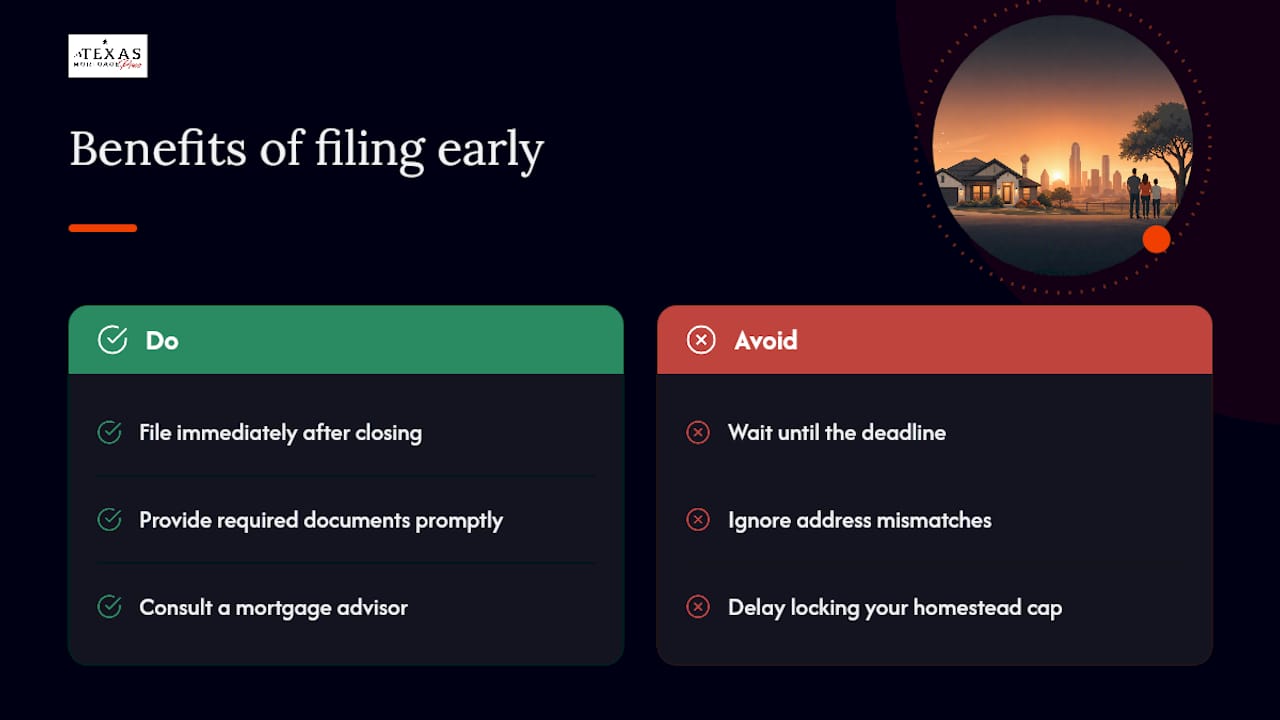
I recommend filing the moment you close on a home, not waiting until the deadline creeps up. Early filing gives the appraisal district time to work through any address mismatch or missing document without threatening your window, and it locks in the homestead cap sooner rather than later. Property taxes are only one piece of homeownership costs, and a mortgage advisor can help you see how exemption savings fit into your broader monthly budget and refinancing decisions.
Get Help Planning Beyond Your Property Tax Savings
Filing your homestead exemption lowers your tax bill, but it’s only one part of what your monthly housing payment looks like. The Texas Mortgage Pros works with a network of over 70 lenders, which means we can help you see how those tax savings actually play out against your mortgage payment, whether you’re buying, refinancing, or just trying to understand where your money goes each month.

Run your numbers through our mortgage calculators to see how a lower taxable value affects your monthly payment, or reach out for a free quote if you’re weighing a purchase or refinance alongside your exemption filing.
Official Forms and County Pages Worth Bookmarking
Save these before you start:
- Form 50-114 and Form 50-135 from the Texas Comptroller
- Harris Central Appraisal District homestead page
- Travis Central Appraisal District exemptions page
- Bexar Central Appraisal District filing instructions
This article is general information, not a substitute for advice from a qualified financial advisor. Consult a qualified financial professional about your own circumstances before acting on anything here.
Sources
- Property Tax Exemptions – Texas Comptroller
- Application for Residence Homestead Exemption (Form 50-114)
- Homestead Exemption – How to Apply – Bexar Central Appraisal District
- Homestead Exemptions | Travis Central Appraisal District
- Homestead – Harris Central Appraisal District