
Expect to put down 15% to 25%, carry a credit score around 660 to 720 or better for competitive pricing, and hold 6 to 12 months of PITI in reserves. Most investors qualify through one of three paths: conventional financing, a DSCR loan, or a portfolio or hard-money product when the deal doesn’t fit agency boxes.
TL;DR:
- Borrowers need at least 15% down on single-unit properties and 25% on two-to-four-unit buildings, with higher down payments improving pricing.
- Credit scores below 660 face higher interest rates, but scores above 720 can secure the best loan-level price adjustments.
- Lenders typically require 6 to 12 months of liquid reserves per property, and qualifying often considers 75% of gross rental income.
- Most approval hurdles stem from reserve shortfalls and credit scores rather than down payment size alone, especially for investors with multiple properties.
- Using a broker to compare different loan types like conventional, DSCR, or portfolio financing improves chances of qualification and better rates.
Table of Contents
- Key Takeaways Before You Apply
- Which Loan Type Fits Your Situation?
- What Are the Exact Down Payment, Credit, and Reserve Requirements?
- Which Documents Will Lenders Actually Ask For?
- Are There Exceptions to the Standard Rental Loan Rules?
- What Rate Premium Should You Expect on an Investment Loan?
- How Do You Actually Prepare and Apply?
- What Do Most Investors Get Wrong About Qualifying?
- Get Matched to the Right Rental Loan Path
- Sources
Key Takeaways Before You Apply
Before diving into the math, here’s the shorthand version investors use to size up a deal fast:
- A single-unit rental typically needs 15% down; 2 to 4 unit properties usually require 25%.
- Credit scores below the mid-600s face higher pricing; scores above 720 generally qualify for better rates.
- Lenders want 6 to 12 months of PITI in reserves per property, and that requirement stacks as you add financed properties.
- If your tax returns don’t show enough qualifying income, or you’re scaling past a handful of properties, a DSCR loan or portfolio product is usually the faster path to approval.
Which Loan Type Fits Your Situation?
The loan type you choose determines almost everything else, from your down payment to your paperwork pile. Here’s how the four common paths stack up:
- Conventional loans work best if you have steady W-2 or well-documented income and you’re still under Fannie Mae’s financed-property limits. They generally offer the lowest rates of the group.
- DSCR loans qualify you based on the property’s rental cash flow instead of your personal income, which makes them a natural fit for self-employed borrowers or investors scaling past a few doors. Pricing runs 1% to 2% higher than conventional, and some carry prepayment penalties.
- Portfolio loans stay on the lender’s own books rather than getting sold to Fannie Mae or Freddie Mac, so underwriting rules are set by that individual lender. This is often the answer once you’ve hit agency caps.
- Hard-money loans are short-term and equity-driven, built for flips or deals that need to close fast rather than long-term holds.
What Are the Exact Down Payment, Credit, and Reserve Requirements?
The numbers below are where most rental purchases either move forward or stall out.
Down payment. Conventional loans require a minimum of 15% down for a single-unit property, though most lenders prefer 20% to 25% for better pricing.
Credit score. Agency guidelines set a technical floor around 620, but in practice, 660 to 700 is where approvals actually become realistic. Above 720, you land in the best loan-level price adjustment tiers, which can shave real money off your rate.
Reserves. Plan on 6 to 12 months of PITI sitting in liquid, verifiable accounts, per financed property. Own three rental properties already? Reserve requirements stack across all of them, not just the one you’re buying.
Under Fannie Mae and Freddie Mac rules, they typically credit 75% of gross rental income toward qualifying, documented through Schedule E, a signed lease, or an appraiser’s Form 1007 rent schedule for a vacant purchase.
DSCR loans base qualification on property cash flow ratios, with most lenders requiring a ratio around or above 1.0 and better terms for higher ratios.
- Pull your credit and know your tier before you shop rates.
- Calculate your DTI including the subject property’s 75%-credited rent.
- If DTI is tight, price out a DSCR loan using the property’s own cash flow instead.
- Confirm your reserve total covers every financed property, not just the new one.
Pro Tip: If your DTI is tight, evaluate qualification both with conventional and DSCR loan calculations. DSCR loans do not consider personal income and may approve deals conventional loans cannot.
Which Documents Will Lenders Actually Ask For?
Paperwork requests vary by lender, but a rental loan file almost always includes the same core stack:
- Two years of personal and, if applicable, business tax returns, with Schedule E covering existing rental income.
- W-2s or a business profit-and-loss statement, depending on how you’re employed.
- Signed leases for occupied rentals, or a comparable rent schedule from the appraiser for a property that’s currently vacant.
- Bank statements proving both your down payment and your reserve funds, with a clear paper trail on where the money came from.
- Gift funds generally aren’t allowed toward investment property reserves, and non-retirement investment accounts are often haircut to around 60% of their value for reserve-counting purposes.
If you’re buying your first rental and have no Schedule E history yet, the appraiser’s rent schedule carries more weight in your file. If PITI on that new property exceeds the rent credited toward qualifying, the shortfall still counts against your DTI.
Are There Exceptions to the Standard Rental Loan Rules?
A handful of program quirks change the math entirely, and missing them is a common way investors misjudge their own eligibility.
- FHA and VA loans allow you to buy a 2 to 4 unit property with a low down payment, but only if you occupy one unit for at least 12 months; 3 to 4 unit purchases also face a self-sufficiency rent test.
- Fannie Mae generally caps a single borrower at around 10 financed properties; beyond that, portfolio, blanket, or commercial financing becomes the practical route.
- Short-term rentals face higher DSCR targets and larger reserve requirements, and you’ll want to check local short-term rental regulations before you close, not after.
- Condos and manufactured housing carry their own lender-specific approval quirks that can rule out an otherwise solid deal.
Pro Tip: For short-term rentals, lenders may require a higher DSCR threshold than standard long-term rentals, so confirm their specific requirements before making an offer as it could affect cash flow calculations.
What Rate Premium Should You Expect on an Investment Loan?
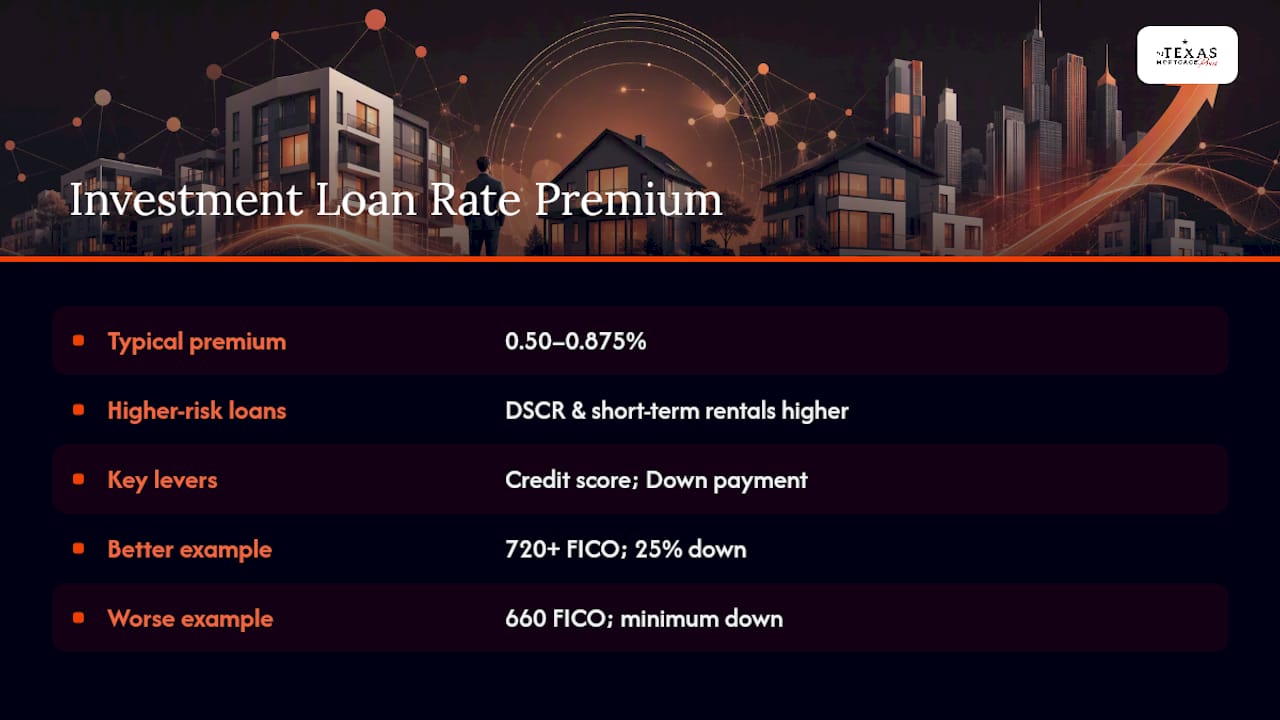
Investment property loans price higher than owner-occupied loans, and the gap comes down to loan-level price adjustments tied to your credit score and loan-to-value ratio. That premium typically runs about 0.50% to 0.875% above a comparable primary-residence loan, with DSCR and short-term rental loans often landing higher still.
Credit score and down payment size are your two biggest levers for shrinking that premium. A borrower at 720+ FICO with 25% down will see meaningfully better pricing than one at 660 with the minimum down payment, sometimes enough to change whether a rental cash flows at all. In some cases, a larger down payment does more for monthly cash flow than chasing a shorter loan term.
How Do You Actually Prepare and Apply?
Once you know your numbers, the application itself follows a fairly predictable sequence:
- Add up total liquidity needed: down payment, closing costs, and 6 to 12 months of PITI reserves per financed property.
- Pick your loan path based on your documentation and how many properties you’re financing; a broker can price DSCR and portfolio options across multiple wholesale lenders at once.
- Line up your appraisal and, where possible, secure lease documentation before you submit your file.
- Get prequalified, compare loan estimates side by side, lock your rate, and prepare your bank statements for underwriting.
Pro Tip: Save toward your reserve target the same way you’d save for a down payment. A dedicated savings strategy that automates monthly transfers gets you to your PITI cushion faster than trying to scrape it together right before closing.
What Do Most Investors Get Wrong About Qualifying?
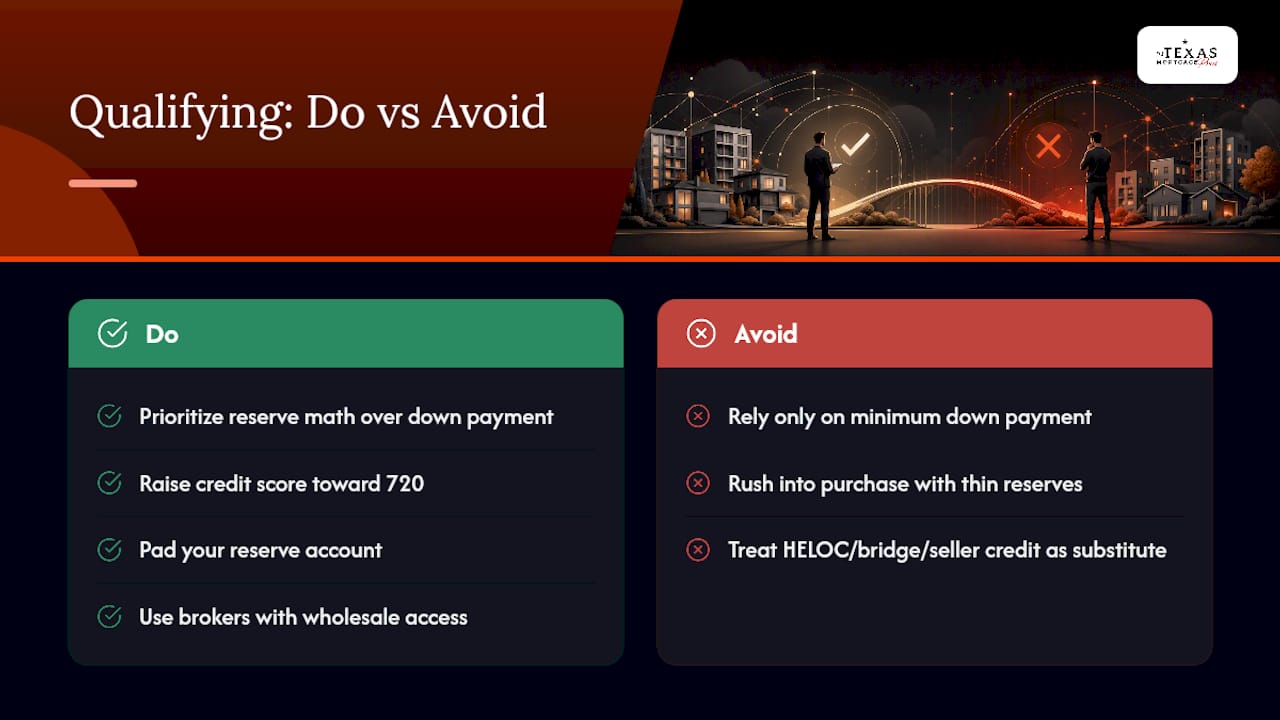
Most investors obsess over the down payment percentage and underrate the reserve math, which is usually what actually sinks a file. Brokers who work with dozens of wholesale lenders can place a borrower with a 1.05 DSCR or a slightly thin reserve cushion into a program a single bank would reject outright. That access matters more than most first-time investors realize.
If you’re on the fence, raising your credit score toward 720 or padding your reserve account almost always beats rushing into a purchase with the bare minimum. Creative options like a HELOC, a bridge loan, or seller-paid closing costs can bridge a real gap, but they shouldn’t be a substitute for basic qualification math.
— Michelle
Get Matched to the Right Rental Loan Path
Figuring out whether you qualify for conventional financing, a DSCR loan, or something else entirely takes more than a calculator. It takes access to lenders who actually write these loans and know how to price them. A brokerage with access to a large network of lenders can shop your file across conventional, DSCR, and portfolio programs instead of squeezing it into whatever one bank happens to offer.

When you request a prequalification, expect a straightforward conversation about your income documentation, your reserve position, and which loan path fits your goals, whether that’s your first rental or your fifteenth. Run your own numbers first using the mortgage calculators to estimate PITI and reserve needs, then explore investment property loan options to see what you’d likely qualify for. Ready to see real numbers? Get a free rate quote and start the conversation today.
Sources
- Investment Property Loan Guide | 2026 Guidelines and Process
- Investment property mortgage — Opendoor article
- Investment property mortgage rates guide — ARVCalc