An investment property is real estate you purchase to generate rental income, profit from resale, or both, rather than a home you live in. For most first-time investors, the simplest and most forgiving strategy is a buy-and-hold single-family rental or a small multifamily house-hack, where you occupy one unit and rent the rest.
Before you fall in love with a listing, check your financing fit. Investment property loans cost more than a primary-residence mortgage and demand bigger down payments, so the numbers that make a deal work often start with what your lender will actually approve.
TL;DR:
- Investment property loans typically require a 20% to 25% down payment and carry interest rates 0.5 to 0.875 percentage points higher than primary residence loans.
- Lenders credit only about 75% of the property’s estimated rent, so conservative underwriting based on this rule is essential for accurate cash flow analysis.
- A strong investment property deal usually shows a debt service coverage ratio of at least 1.25 and a cap rate between 5% and 8%, targeting higher cash-on-cash returns.
- Self-managing one to two units nearby works for owners with time and the right temperament; larger portfolios often require hiring professional property managers.
- New investors should prepare two years of tax returns, rent comps, and reserve funds before engaging lenders to streamline approval and avoid delays.
Table of Contents
- What Types of Investment Property Fit Your Goals?
- Is Buying an Investment Property Worth the Risk?
- How Do You Finance an Investment Property?
- How Do You Analyze an Investment Property Deal?
- How Do You Buy an Investment Property Step by Step?
- Should You Self-Manage or Hire a Property Manager?
- What Mistakes Should First-Time Investors Avoid?
- How Do You Analyze a Market Before You Invest?
- What Does an Investment Property Actually Cost Long-Term?
- What Legal Rules Should Investors Know Before Renting?
- When Does a Mortgage Broker Actually Help Investors?
- Ready to Explore Investment Property Financing?
- Key Takeaways
- Sources
What Types of Investment Property Fit Your Goals?
Not every strategy suits every investor, and the one you pick should match your capital, your schedule, and how much risk you can absorb without losing sleep.
Buy-and-hold single-family homes and small multifamily properties (duplexes, triplexes, fourplexes) remain the backbone of rental property investment. You buy, rent it out, collect monthly cash flow, and let appreciation build equity over years. This works best for investors who want steady income without daily involvement once a tenant is in place.

House-hacking is the fastest on-ramp for someone with limited capital. You buy a 2 to 4 unit property, live in one unit, and rent the others. Because you’re technically owner-occupying, you can often qualify with an FHA or VA loan, which brings the down payment down dramatically compared to a straight investment loan. The catch: you must actually live there, typically for at least a year, before converting to a true rental.
Flips and the BRRRR method (buy, rehab, rent, refinance, repeat) trade time and labor for faster equity gains. They demand contractor relationships, accurate repair budgeting, and tolerance for financing that’s harder to secure. Short-term rentals add another layer: strong cash flow potential in tourist markets, offset by local permitting rules and seasonal vacancy swings that vary block by block.
If you want real estate exposure without tenants, maintenance calls, or a mortgage application, REITs let you buy shares in professionally managed portfolios. You trade control and leverage for liquidity and simplicity, which is a completely reasonable trade for some investors.
Is Buying an Investment Property Worth the Risk?
Real estate investing works because a handful of financial mechanics stack in your favor when you hold the right property.
- Leverage lets you control a $300,000 asset with a fraction of that in cash, amplifying returns on the capital you actually put in.
- Tax benefits including depreciation and deductible operating expenses can shrink your taxable rental income even while cash flow stays positive.
- Appreciation and amortization work together over time, since your tenant’s rent is paying down your loan balance while the property (ideally) gains value.
The downsides are just as real. Property is illiquid. You can’t sell a rental in a week if you need cash. Management eats time, even when you hire it out, and a single property concentrates risk in one asset, one neighborhood, one local economy. Rising interest rates hit refinancing plans and new purchase math hard.
Skip this asset class, at least for now, if you don’t have three to six months of reserves set aside, you’re unwilling to handle (or pay someone to handle) tenant issues, or the market you’re eyeing has flat rents and falling population.
How Do You Finance an Investment Property?
Financing is where most first-time investors get surprised, and it’s the piece worth solving before you write an offer. Investment property mortgages in 2026 typically price 0.5 to 0.875 percentage points above primary-residence rates, a premium driven by loan-level price adjustments that lenders apply because non-owner-occupied loans carry more default risk.
Your loan type options break down like this:
- Conventional conforming loans offer the lowest rates and most predictable underwriting for W-2 borrowers with a handful of financed properties.
- DSCR loans qualify you on the property’s rental income instead of your personal tax returns, which makes them the go-to for self-employed investors or anyone scaling past a few doors.
- Portfolio and non-QM loans fill gaps conventional guidelines can’t, often used for unique properties or borrowers with inconsistent income documentation.
- Hard money loans fund fast, short-term deals like flips, at higher cost, for investors who need speed over price.
- FHA and VA loans apply only when you occupy one unit of a 2 to 4 unit property yourself, a narrow but valuable carve-out for house-hackers.
Statistic to know: current 2026 fixed investment property rates run roughly 6.125% to 7.5%, with down payments commonly landing between 20% and 25% and a practical credit-score target of 700 or higher for the best pricing tiers.
They typically credit 75% of the estimated market rent, applying a 25% haircut to account for vacancy and expenses, whether the property already has a lease or the number comes from an appraiser’s rent estimate. Expect reserve requirements of six months of principal, interest, taxes, and insurance on the subject property, and know that Fannie Mae caps the number of financed properties a single borrower can carry.
Pro Tip: Bring two years of tax returns, a profit-and-loss statement if you’re self-employed, and comparable rent data for the neighborhood to your first conversation with a broker. That single step often cuts weeks off approval time, since it’s preparation, not credit score, that moves closing dates.
Reviewing investment property loan options before you shop for a property tells you what price range your financing can actually support.
How Do You Analyze an Investment Property Deal?
A handful of metrics separate a property that looks good on a listing sheet from one that actually performs.
- Net Operating Income (NOI) equals gross rental income minus operating expenses (not including the mortgage). This is your baseline profitability number.
- Cap rate equals NOI divided by purchase price. It tells you the unleveraged return the property produces, useful for comparing deals across neighborhoods.
- Cash-on-cash return equals annual cash flow after debt service, divided by the actual cash you put in. This is the number that reflects your leveraged, real-world return.
- Debt Service Coverage Ratio (DSCR) equals rental income divided by the mortgage payment. Lenders want to see at least 1.0, with 1.25 or higher earning better pricing.
- Gross Rent Multiplier (GRM) equals purchase price divided by annual gross rent, a quick screening tool before you dig into expenses.
Here’s a worked example using conservative assumptions. Say you’re looking at a single-family rental priced at $250,000, with market rent of $2,000 a month.
Subtract realistic expenses, property taxes, insurance, maintenance, vacancy reserve, and property management, and your NOI lands around $12,000 a year. That gives you a cap rate of 4.8%.
That DSCR clears the 1.0 minimum but sits below the 1.25 sweet spot, a signal to negotiate price, raise the down payment, or look for higher rent-to-price ratios elsewhere. Most experienced investors target cap rates in the 5% to 8% range depending on market, a DSCR of 1.25 or better, and cash-on-cash returns that beat what they’d earn parking the same cash elsewhere.
How Do You Buy an Investment Property Step by Step?
Buying rental property rewards a sequence, not a sprint. Skip a step and you’ll pay for it later, usually at closing or with your first tenant.
- Get your finances in order first. Calculate your available down payment, closing costs, and required reserves, then get preapproved so you know your real price ceiling before you fall for a listing.
- Define your buy box and research the market. Decide on property type, price range, and target neighborhoods, then run comps on both sale prices and rents. A property that looks cheap in a declining rental market isn’t actually cheap.
- Make an offer with the right protections. Include an inspection contingency, negotiate seller concessions where the market allows, and keep earnest money proportional to the deal, enough to show you’re serious, not so much it exposes you if the deal falls through.
- Run a thorough due diligence checklist. Prioritize roof, foundation, plumbing, and electrical during inspection, review the title for liens or easements, and confirm HOA rules and insurance costs before your contingency period expires.
- Close and set up operations. Secure landlord insurance (different from a homeowner policy), open a separate bank account for the property’s income and expenses, use a solid lease template, and screen tenants with credit, income, and rental history checks before handing over keys.
Pro Tip: Order your inspection and your insurance quote in the same week. Insurers sometimes flag issues, like an aging roof, that change your negotiating position before your inspection contingency deadline hits.
For a deeper look at how rental income factors into your buying power, see how leveraging rental income works with investment property mortgages.
Should You Self-Manage or Hire a Property Manager?
A plumbing emergency works well for investors with one or two properties nearby and the temperament to handle conflict directly.
Hiring a professional manager makes sense once you own multiple properties, live far from your rentals, or simply want your evenings back. A good manager handles leasing, maintenance vendors, rent collection, and legal compliance, worth the fee if it keeps units filled and avoids costly mistakes.
Scaling a portfolio eventually runs into financing limits. Conventional conforming loans cap how many financed properties one borrower can hold, which pushes growing investors toward DSCR and portfolio loans that don’t count against those same caps. When you’re ready to exit, your main paths are refinancing to pull out equity, a 1031 exchange to defer capital gains taxes by rolling proceeds into another property, selling outright, or converting the property to your primary residence.
- Self-manage for one to two nearby units if you have the time and temperament.
- Hire a manager once you’re remote, scaling past two or three doors, or short on time.
- Expect financed-property caps to eventually push you toward DSCR or portfolio loans.
- Plan your exit (refinance, 1031, sale, or conversion) before you need the liquidity, not after.
What Mistakes Should First-Time Investors Avoid?
Most investment property losses trace back to the same handful of preventable errors.
- Underbudgeting repairs and reserves. Add a conservative maintenance contingency on top of your estimate, then add reserves on top of that.
- Misclassifying occupancy. Claiming a property as owner-occupied when you don’t intend to live there violates loan terms and can trigger loan recall.
- Skipping the inspection or rushing tenant screening. Both are cheap insurance against expensive surprises.
- Over-leveraging without stress-testing rates. Model your cash flow at rates two points higher than today’s before you commit.
Pro Tip: Run your cash-flow numbers at a mortgage rate two percentage points above your actual quote. If the deal still works, you have real cushion. If it doesn’t, you’ve found your risk before it found you.
How Do You Analyze a Market Before You Invest?
Picking the right location matters as much as picking the right property, and it starts with data, not a gut feeling about a neighborhood you liked visiting once.
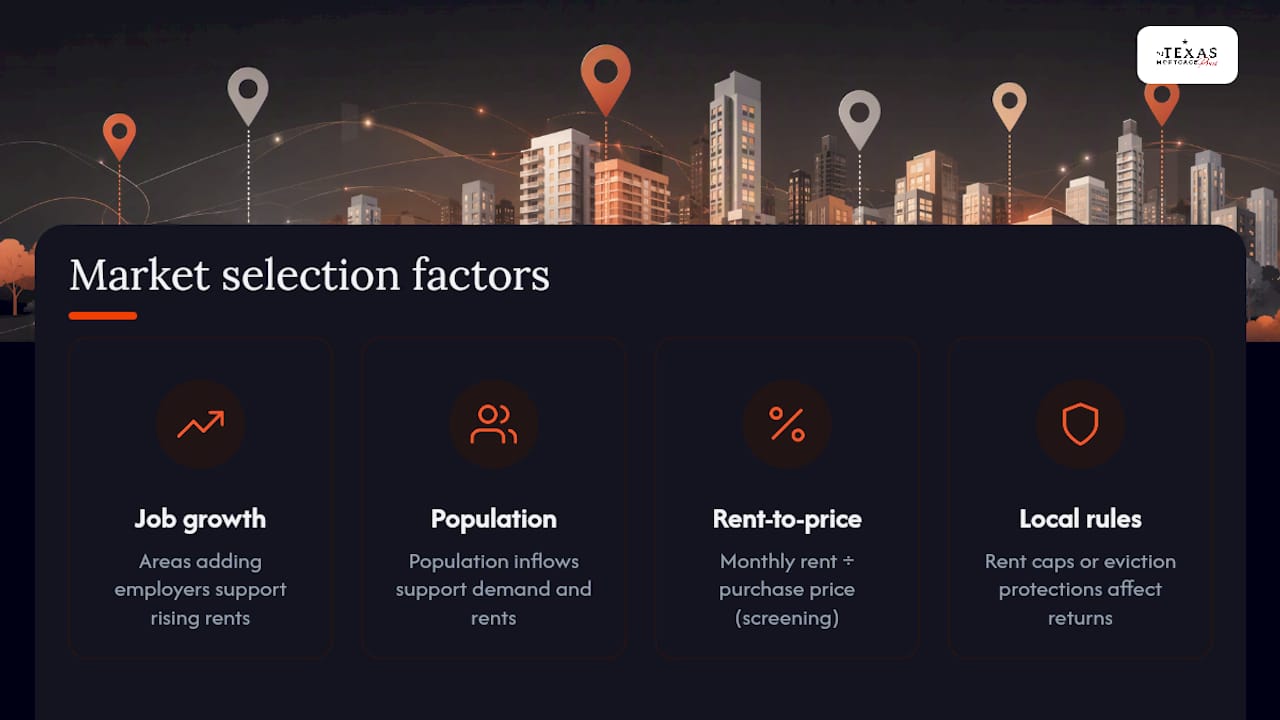
Job growth and population trends are the foundation. Areas adding employers and residents tend to support rising rents and lower vacancy, while shrinking metros often mean the opposite no matter how low the purchase price looks.
Rent-to-price ratios help you screen quickly across neighborhoods. Divide monthly rent by purchase price.
School district quality, crime data, and planned infrastructure (new transit lines, employer relocations, zoning changes) all move rents and resale value over a five to ten year hold. Cross-reference local landlord-tenant regulations too. Some cities cap rent increases or add eviction protections that materially change your operating assumptions before you ever sign a purchase contract.
Best locations for investment property share a pattern: steady job growth, population inflows, reasonable rent-to-price ratios, and landlord-friendly (or at least landlord-neutral) local rules.
What Does an Investment Property Actually Cost Long-Term?
The purchase price is the smallest surprise in real estate investing. The ongoing costs are what determine whether a deal actually performs.
Property taxes vary significantly by county and can climb after a reassessment triggered by your own purchase. Insurance for a non-owner-occupied property costs more than a standard homeowner policy, and premiums have been climbing in many markets due to weather-related claims. Budget for maintenance and capital expenditures separately: routine upkeep (lawn care, minor repairs) runs differently than big-ticket items like a roof or HVAC replacement, which you should reserve for even if nothing breaks this year.
Add vacancy loss, the rent you don’t collect between tenants, property management fees if you hire out, and HOA dues if the property has them. Utilities you cover (some landlords include water or trash) belong in the model too.
If your projected NOI doesn’t survive that stress test, the deal’s margin is thinner than it looks. The IRS provides detailed guidance on deductible rental expenses, and tracking these categories consistently from day one makes tax season, and future refinancing, far less painful.
What Legal Rules Should Investors Know Before Renting?
Landlord-tenant law varies by state and often by city, which means a lease template that works in one market can violate rules in another. Security deposit limits, notice periods for entry, and eviction procedures are usually spelled out at the state level, and getting them wrong can cost you a case in court even when your underlying complaint against a tenant is valid.
Fair housing law applies nationwide. You cannot discriminate based on protected characteristics in advertising, screening, or lease terms, and violations carry real financial exposure regardless of intent. Local ordinances sometimes add rent control, just-cause eviction requirements, or short-term rental permitting on top of state rules, so a strategy that pencils out in one city can be illegal two counties over.
Before you close, confirm zoning allows your intended use (rental, short-term rental, multi-unit), check whether the property requires a landlord license or registration, and review any HOA restrictions on renting. None of this replaces a conversation with a local real estate attorney, particularly for your first purchase, but knowing the categories to ask about saves you from finding out the hard way.
When Does a Mortgage Broker Actually Help Investors?
A broker’s value shows up most clearly when your deal doesn’t fit a standard box. Access to dozens of lenders means finding a DSCR or portfolio program suited to your specific income documentation or property type, rather than accepting a single bank’s one-size-fits-all guidelines.
What speeds approval isn’t a slightly better credit score. It’s showing up with two years of tax returns, a profit-and-loss statement if you’re self-employed, and rent comps ready to go. That preparation, paired with a broker who already knows which lenders favor investor files, shaves real time off closing.
One caveat worth repeating: verify local property tax rates and landlord-tenant rules directly, since they shift by county and city.
— Michelle
Ready to Explore Investment Property Financing?
Once you know your numbers, the next question is which loan actually fits your file, and that’s where a broker earns their keep instead of a single bank’s limited menu. The Texas Mortgage Pros works with a network of more than 70 lenders, which means access to DSCR programs, portfolio loans, and conventional investment financing side by side, so you’re not stuck with whatever one lender happens to offer that week.

If you’re modeling a purchase right now, start by running your numbers through the mortgage calculators to see real payment scenarios at current rates. When you’re ready to talk financing specifics, bring two years of tax returns, a rent estimate or existing lease, and your reserve documentation to a conversation with the team. Explore the investment property loan options available in Texas and get a personalized rate check before you make your next offer.
Key Takeaways
| Point | Details |
|---|---|
| Pick a starter strategy | Buy-and-hold single-family or house-hacking a small multifamily suits most first-time investors. |
| Budget for the rate premium | Investment loans price 0.5 to 0.875 points above primary-residence rates with 20% to 25% down. |
| Know the 75% rent rule | Lenders credit only 75% of market rent when qualifying you, so underwrite conservatively. |
| Run the core metrics | Target a DSCR of 1.25 or better and cap rates in the 5% to 8% range before committing. |
| Match the loan to the borrower | The Texas Mortgage Pros connects W-2 and self-employed investors to conventional, DSCR, and portfolio options across 70+ lenders. |
Sources
Check consumerfinance.gov for rate guidance, IRS rental income rules, and HUD Home Store for listings.
- Opendoor — Investment property mortgage overview
- Mortgage Mastermind — investment property financing requirements
Recommended
- Investment Property Loans & Mortgage Rates in Texas
- Investment Property Mortgage Down Payments: What You Need To Know – The Texas Mortgage Pros
- Investment Property Loan Options: Finding The Right Fit For Your Goals – The Texas Mortgage Pros
- Leveraging Rental Income: Using Investment Property Mortgages To Build Passive Income – The Texas Mortgage Pros