
How to compare mortgage lenders and loan offers effectively
The most effective way to compare mortgage lenders is to request standardized Loan Estimates from at least three lenders and review them side by side. Every lender is legally required to provide this three-page document within three business days of your application, and every form uses the same layout, so you are always comparing the same line items. The key factors to evaluate across offers are:
- Interest rate: Even a small difference compounds over 30 years. For adjustable-rate mortgages, check the worst-case cap scenario.
- Total origination charges: Found in Section A of page 2. These are fees your lender controls directly.
- Monthly payment: Compare principal, interest, mortgage insurance, and escrow together, not just the base payment.
- Closing costs and lender credits: Section J lists any credits the lender offers to offset your cash at closing.
- Loan term and type: A 15-year fixed and a 30-year fixed at the same rate produce very different total costs.
Lender service quality belongs on this list too. A lender who takes four days to return a call during pre-approval will likely move just as slowly at closing. The CFPB guidance on contacting multiple lenders is clear: responsiveness and transparency during early conversations predict the quality of the entire mortgage process.
Pro Tip: Once you have two or three Loan Estimates in hand, use them as leverage. Lenders often match or beat a competitor’s offer when you show them a better deal in writing.
How do you request and review Loan Estimates step by step?
Getting comparable offers requires a little preparation upfront, but the process is straightforward once you know what to ask for.

Step 1: Identify your lenders. Cast a wide net. Contact banks, credit unions, and mortgage brokers. If you are a veteran or a first-time buyer, look for lenders who specialize in VA or FHA loan programs. The CFPB recommends getting at least three offers to ensure competitive pricing.
Step 2: Request pre-approval from each lender. Pre-approval triggers the Loan Estimate. You do not need to submit written documentation to request one, but you will need to share your income, assets, and property details so each lender can price the loan accurately.
Step 3: Ask for the same loan type from every lender. If you want a 30-year fixed conventional loan, request that exact product from all three. Mixing loan types makes comparison meaningless.
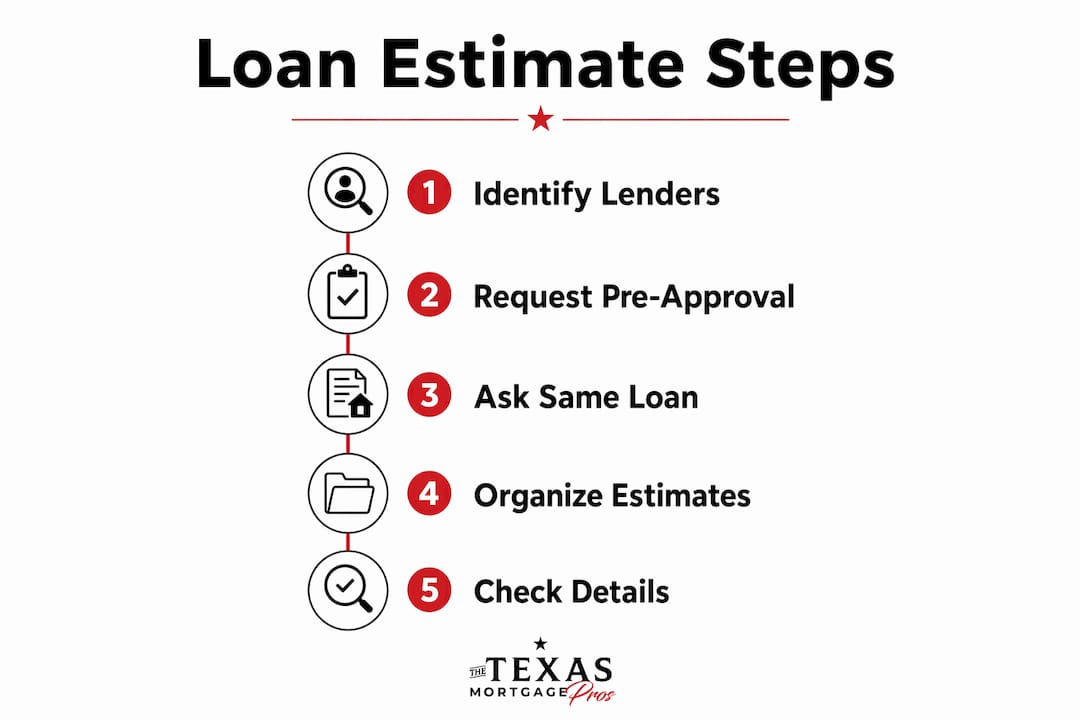
Step 4: Organize your Loan Estimates side by side. Use a simple spreadsheet or the CFPB’s Loan Estimate comparison tool to line up the key figures.
Step 5: Check for errors and risky features. Confirm your name, property address, and loan amount are correct on every form. Look for prepayment penalties or balloon payments listed under Loan Terms on page 1, and ask the lender to explain any feature you did not request.
| What to compare | Where to find it on the Loan Estimate |
|---|---|
| Interest rate | Page 1, Loan Terms box |
| Monthly payment | Page 1, Projected Payments |
| Origination charges | Page 2, Section A |
| Lender credits | Page 2, Section J |
| Cash to close | Page 2, bottom summary |
| Five-year cost | Page 3, Comparisons section |
Pro Tip: Check whether your rate is locked on each Loan Estimate. An unlocked rate can change before closing, making your comparison less reliable.
What should you look for in a lender beyond the numbers?
The interest rate gets all the attention, but the lender’s behavior tells you just as much. Pre-approval is your best test. How quickly does the loan officer respond? Do they explain fees clearly, or do they deflect questions? Experts view pre-approval as a direct preview of how the lender will handle your file all the way to closing.

When researching lender reputation, look at verified reviews on platforms like Google and the CFPB’s complaint database. Pay attention to patterns, not individual reviews. One complaint about slow communication is noise; a dozen complaints about the same issue are a pattern worth taking seriously.
Watch for these red flags:
- A lender asks you to pay fees beyond a credit report pull before issuing a Loan Estimate. By law, that is the only upfront charge allowed at this stage.
- The written Loan Estimate differs significantly from what the loan officer described verbally.
- The lender pushes you toward a loan type you did not ask for without a clear explanation.
- Communication slows or stops after you submit your application.
Pro Tip: Ask each loan officer directly: “Can you close by my contract date?” A lender who hesitates or gives a vague answer is a risk to your purchase timeline.
Checking lender credentials through your state’s mortgage licensing database is also worth the few minutes it takes. Licensed loan officers are required to be registered under the Nationwide Multistate Licensing System (NMLS), and you can verify their status online at no cost. For more guidance on evaluating fit, the evaluation criteria at Lending Gurus cover what separates a reliable lender from one that will cost you time and money.
How does mortgage rate shopping affect your credit score?
Shopping multiple lenders does not hurt your credit the way many buyers fear. Credit scoring models treat all mortgage-related hard inquiries within a 45-day window as a single inquiry, regardless of how many lenders pull your report. That means you can contact five lenders in week one and two more in week three without any additional credit impact beyond the first pull.
A few distinctions worth knowing:
- Hard inquiry vs. soft inquiry: Checking your own credit is a soft inquiry and has zero effect on your score. A lender pulling your report for a pre-approval is a hard inquiry, which typically causes a small score drop of less than five points.
- The 45-day rule applies to mortgage inquiries specifically. Shopping for a car loan at the same time creates a separate inquiry category and can compound the impact.
- Checking your own report first is free and a smart move. You can pull your report at AnnualCreditReport.com before any lender does, fix errors, and go into the process with a clear picture of where you stand.
The long-term math strongly favors shopping around. The short-term credit dip from a hard inquiry fades within a few months. The savings from finding a better rate can last the life of your loan. For Texas buyers looking to protect their score while finding the best deal, these tips for securing competitive rates walk through the timing in detail.
What mortgage terms and fees should you understand before comparing offers?
Two offers can look identical on the surface and carry very different true costs. Understanding the key terms prevents you from choosing the wrong loan.
Interest rate vs. APR: The interest rate is what you pay to borrow the principal. The Annual Percentage Rate (APR) folds in lender fees and certain closing costs, expressing your total cost as a single annual percentage. APR is the more complete number for comparison, though it assumes you keep the loan for its full term.
Loan types at a glance:
- Fixed-rate: Your rate and payment stay the same for the life of the loan. Predictable and lower risk.
- Adjustable-rate (ARM): Starts lower, then adjusts periodically based on a market index. Can save money short-term but carries rate risk.
- FHA loans: Government-backed, lower down payment requirements, and more flexible credit standards. Require mortgage insurance premiums.
- VA loans: Available to eligible veterans and active-duty service members. No down payment required and no private mortgage insurance.
Key fees to watch:
- Origination charges: Lender fees for processing your loan. These vary by lender and are negotiable.
- Prepaid items: Interest, homeowner’s insurance, and property taxes collected at closing to fund your escrow account.
- Lender credits: A rebate from the lender that reduces your closing costs in exchange for a slightly higher rate.
- Prepayment penalty: A fee charged if you pay off the loan early. Not all loans carry one, but check page 1 of the Loan Estimate under Loan Terms.
Pro Tip: Use the “In 5 Years” line on page 3 of each Loan Estimate to calculate your true five-year borrowing cost. Subtract the principal paid from the total paid, and you get the actual interest and fees you will have spent. This single calculation often reveals which offer is genuinely cheaper.
| Term | What it means for your comparison |
|---|---|
| APR | Total annual cost including fees, not just the rate |
| Origination charges | Lender-controlled fees; compare Section A across all offers |
| Lender credits | Offset closing costs; a higher credit may mean a higher rate |
| “In 5 Years” figure | True cost of borrowing over the first five years |
| Prepayment penalty | Extra cost if you sell or refinance early |
How The Texas Mortgage Pros simplifies your mortgage comparison
Comparing Loan Estimates across multiple lenders takes time, and the details matter. The Texas Mortgage Pros works with a network of over 70 lenders to pull competitive offers on your behalf, so you are not spending weeks contacting lenders one by one. The team handles the comparison work and presents you with clear, side-by-side options tailored to your financial situation.
From pre-qualification through closing, every step comes with expert guidance. Whether you are a first-time buyer trying to understand the difference between FHA and conventional loans, a veteran exploring VA options, or an investor evaluating loan structures, The Texas Mortgage Pros matches you with the right product and fights for the rate you deserve.
The advantages of working with The Texas Mortgage Pros include:
- Access to conventional, FHA, VA, and specialty loan programs through a single point of contact
- Expert review of your Loan Estimates to flag fees, risky features, and negotiation opportunities
- Guidance on timing your applications within the 45-day credit inquiry window
- Support for buyers in challenging situations who need a lender willing to work harder
Not all mortgage lenders approach the process the same way. For a closer look at what separates a lender worth trusting from one that will slow you down, read how to choose the right lender.
Ready to compare real mortgage offers for your Texas home?
Comparing mortgage lenders on your own is possible, but it takes time, attention to detail, and the patience to negotiate. The Texas Mortgage Pros gives you a faster path to the same outcome: competitive rates, clear terms, and a loan that fits your goals.

Use our mortgage calculators to model different loan scenarios before you apply, then reach out to our team to request real Loan Estimates from our network of 70+ lenders. You can also check current Texas mortgage rates and get a free quote today. We work with first-time buyers, veterans, and experienced investors across Texas, and we are ready to help you close with confidence.
Key Takeaways
Requesting Loan Estimates from at least three lenders within a 45-day window is the single most effective way to compare mortgage offers and protect your credit score while doing it.
| Point | Details |
|---|---|
| Use Loan Estimates for comparison | Lenders must provide this standardized form within three business days of your application. |
| Shop within 45 days | All mortgage credit inquiries within this window count as a single hard inquiry on your report. |
| Focus on fees, not just rates. | Compare origination charges in Section A and lender credits in Section J across every offer. |
| Calculate your five-year cost. | Subtract principal paid from total paid on page 3 to find your true borrowing cost. |
| The Texas Mortgage Pros | Access 70+ lenders through one team for side-by-side offers, expert review, and negotiation support. |