
In Texas, a home purchased during marriage is presumptively community property, and the mortgage that comes with it is a shared debt, regardless of whose name appears on the title or loan. That single fact has major consequences when a marriage ends. A divorce decree can award the house to one spouse, but it cannot remove the other spouse from the promissory note. Only a refinance, a lender-approved assumption, or a full payoff at sale accomplishes that. If you are keeping the home, plan to refinance promptly after the decree is signed, and insist on a fallback sale provision if the refinance falls through.
Here is what Texas community property law means for your mortgage in practical terms:
- A home bought during marriage is community property under Tex. Fam. Code § 7.001, regardless of whose name is on the deed.
- A home bought before marriage is generally separate property, but community funds used to pay the mortgage or make improvements can create reimbursement claims.
- The deed (title) and the promissory note (loan obligation) are legally separate instruments. A court can transfer the deed; it cannot release a signer from the note.
- Lenders can pursue any original signer for missed payments, even after a divorce decree assigns the home to the other spouse.
- The only reliable exits from mortgage liability are refinancing into one name, a lender-approved assumption, or selling the home.
Table of Contents
- How does Texas community property law affect your mortgage?
- What is the inception-of-title rule, and does it protect your pre-marital home?
- How are mortgages and debts divided in a Texas divorce?
- How reimbursement claims work when marital funds pay a separate-property mortgage
- What happens to a home bought during the marriage?
- Step-by-step: how to remove a spouse from a mortgage after divorce
- What can a lender actually do after your divorce?
- How to protect your separate property and preserve reimbursement claims
- What lenders actually require: owelty liens, refinance thresholds, and realistic timelines
- Common myths about community property and mortgages in Texas
- Key Takeaways
- What practitioners know about Texas divorce-mortgage cases
- Ready to check your refinance options? The Texas Mortgage Pros can help.
- Authoritative sources and further reading
How does Texas community property law affect your mortgage?
Texas is one of nine community property states in the U.S., and its rules are among the most consequential for homeowners. Under Texas Family Code Chapter 3, community property includes all property acquired by either spouse during the marriage, with limited exceptions. Earnings, bank accounts, and real estate purchased with marital income all fall under this umbrella.
The statute also establishes a clear presumption: any property possessed by either spouse during or at the dissolution of the marriage is presumed to be community property. Overcoming that presumption requires clear and convincing evidence, which is a high legal bar.
“In general, this means that any property acquired by a couple during their marriage (with a few exceptions) is equally owned by both spouses. This can have a profound effect on the dissolution of property during divorce proceedings.” — Texas State Law Library, Community Property Guide
Division at divorce follows a “just and right” standard under Tex. Fam. Code § 7.001, not an automatic 50/50 split. Judges weigh factors like earning capacity, fault in the marriage breakdown, child custody arrangements, and each spouse’s separate estate. That discretion means outcomes vary significantly from case to case.
Community property typically includes:
- Wages and salaries earned during marriage
- A home purchased during marriage, even if only one spouse is on the deed
- Mortgage debt incurred during marriage
- Retirement contributions made during marriage
Separate property typically includes:
- Property owned before marriage
- Gifts or inheritances received by one spouse, even during marriage
- Personal injury recoveries (except for lost wages)
- Property clearly traced to pre-marital funds
What is the inception-of-title rule, and does it protect your pre-marital home?
A house you owned before marriage is generally your separate property, and it stays that way under the inception-of-title rule. Texas law fixes the character of property at the moment it is acquired. If you bought the home before the wedding, its foundational character is separate, and marriage alone does not change that.

The complication arises during the marriage. If community funds, meaning money earned by either spouse after the wedding, are used to pay down the mortgage principal or fund significant improvements, the community estate may have a reimbursement claim against your separate property. The home’s title stays in your name, but your spouse can argue the community is owed money back for what it contributed.
Here is how commingling typically defeats separate-property status or creates claims:
- Community funds pay the mortgage. Monthly payments made from a joint checking account reduce the principal on a separate-property home. The community can seek reimbursement for that principal reduction.
- You add your spouse to the warranty deed. This is treated as a gift of ownership interest. Courts may characterize all or part of the home as community property from that point forward.
- You refinance jointly during marriage. A joint refinance can blur the inception-of-title record and create arguments that the property was transmuted to community.
- Funds are commingled in a joint account. If separate funds and community funds mix in the same account and you cannot trace which dollars paid which expenses, the separate character is lost.
Example scenario: You bought a home in 2018 for $280,000 using your own savings. You married in 2020. From 2020 to 2025, you and your spouse paid the mortgage from a joint account, reducing the principal by $35,000. At divorce, the community estate has a reimbursement claim for that $35,000 in principal reduction, even though the home’s title remained in your name throughout.
Pro Tip: Keep your original closing disclosure, pre-marital bank statements, and a separate account for all pre-marital property expenses. The cleaner the paper trail, the stronger your separate-property claim. Learn more about how Texas mortgage rules interact with ownership in this guide to Texas mortgage law.
How are mortgages and debts divided in a Texas divorce?
Courts can divide the home. They cannot divide the loan. That distinction is the most important thing to understand about Texas divorce property laws and mortgage liability.

When a judge awards the home to one spouse, that spouse receives the deed. But the promissory note, the legal contract with the lender, remains binding on every person who signed it. The lender retains full contractual rights against all original signers regardless of what the decree says. If the keeping spouse misses a payment, the lender can report the delinquency on the departing spouse’s credit, pursue collections, or initiate foreclosure.
Courts typically resolve this through one of four approaches:
- Award to one spouse with a refinance deadline. The keeping spouse is ordered to refinance within a set period, commonly 60–90 days, to remove the other from the note. The decree should include a fallback sale provision if the refinance fails.
- Ordered sale and split of proceeds. The home is sold, the mortgage is paid off, and the remaining equity is divided according to the court’s “just and right” determination.
- Owelty lien assignment. The home is awarded to one spouse, and an owelty lien is recorded to secure the departing spouse’s equity share. The keeping spouse pays that amount at refinance closing.
- Underwater mortgage disposition. When the mortgage balance exceeds the home’s value, courts may order a short sale, deed-in-lieu, or assign the deficit to one spouse in exchange for other marital assets. Lenders still enforce the debt regardless of the court’s assignment.
A divorce decree is a contract between spouses, not a release from the promissory note. Lenders require a refinance or assumption to remove liability and can still pursue both signers for any default.
Pro Tip: Insist that the decree specifies a 60–90 day refinance deadline with an automatic fallback ordering the home listed for sale if the refinance is not completed. Also include indemnity language requiring the keeping spouse to hold the departing spouse harmless from any mortgage liability incurred after the decree date.
How reimbursement claims work when marital funds pay a separate-property mortgage
Separate property stays separate, but the community estate does not walk away empty-handed when it has funded that property. Texas courts apply the reimbursement doctrine, grounded in Tex. Fam. Code § 7.007 and tracing principles, to compensate the community for contributions made to a spouse’s separate estate.
Reimbursement claims are measured in two main ways. First, the community can recover the amount by which mortgage principal was reduced using community funds during the marriage. Second, if community funds paid for capital improvements, the claim is measured by the enhancement in value those improvements produced, not just the cost of the work.
Simple reimbursement calculation example:
| Item | Amount |
|---|---|
| Principal reduction during marriage | $35,000 |
| Portion paid from community funds (documented) | $28,000 |
| Community reimbursement claim | $28,000 |
The $28,000 figure is what the community estate could claim back from the separate estate, assuming proper tracing documentation exists. If the funds came from a commingled account, the claim becomes harder to prove and may be reduced or denied.
Documents needed to support or defend a reimbursement claim:
- Original closing disclosure from the pre-marital purchase
- Pre-marital bank statements showing the down payment source
- Loan payoff history showing principal balance at the date of marriage
- Monthly mortgage statements throughout the marriage
- Receipts and contractor invoices for any capital improvements
- Bank records showing which account funded each payment
Common tracing pitfalls to avoid:
- Depositing separate funds into a joint checking account used for household expenses
- Making undocumented cash transfers between accounts
- Failing to keep improvement receipts or contractor records
- Refinancing without documenting the separate-property equity carried forward
Understanding how mortgage payments break down between principal and interest is critical here, because only principal reduction creates a reimbursement claim, not interest payments or escrow contributions.
What happens to a home bought during the marriage?
A home purchased during marriage is presumptively community property under Texas law. It does not matter if only one spouse is on the deed, only one spouse signed the loan, or only one spouse made every payment. The community presumption attaches at the moment of purchase.
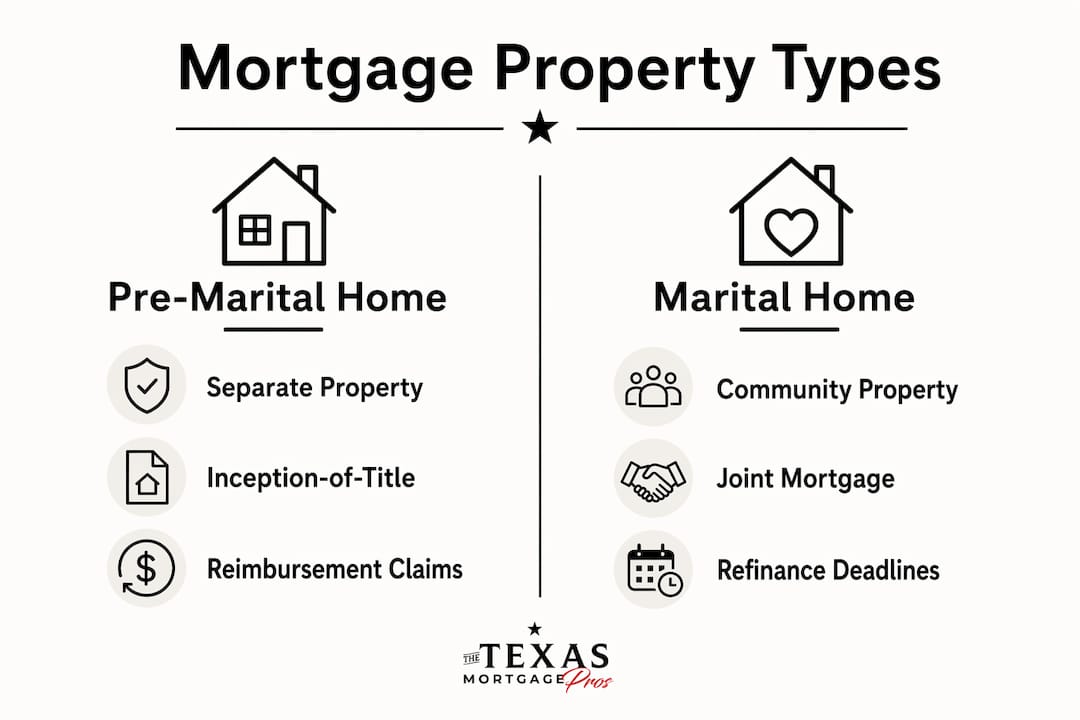
Courts value the community’s interest in the home by calculating equity: current market value minus the outstanding mortgage balance. That equity is then divided “just and right,” which may or may not be equal depending on the judge’s findings on fault, earning capacity, and the needs of any children.
Typical division options for a community-owned home:
- One spouse keeps the home and refinances. The keeping spouse qualifies for a new loan in their name alone, pays off the joint mortgage, and may pay the other spouse a cash buyout for their equity share.
- Both spouses agree to sell. Proceeds pay off the mortgage, and the remaining equity is split per the decree.
- Court orders a partition and sale. If spouses cannot agree, a judge can order the home sold and proceeds divided.
Short case example: A couple bought a home in 2019 for $350,000 with a joint mortgage. At divorce, the home appraises at $430,000, and the mortgage balance is $310,000, leaving $120,000 in equity. The court awards the home to one spouse with a 90-day refinance deadline. That spouse must qualify for a new $310,000 loan on their income alone and pay the other spouse $60,000 as their equity share, either in cash or through an owelty lien at closing.
Mortgage payments made during the divorce process can factor into the final division, but they are not automatically credited as equity. Courts look at whether payments came from community funds and whether proper tracing exists before granting any credit.
Step-by-step: how to remove a spouse from a mortgage after divorce
The only reliable ways to remove a spouse from lender liability are refinancing the loan into one name, a lender-approved assumption, or paying off the mortgage entirely through a sale. A decree alone accomplishes none of these.
- Confirm who is on the note and the deed. Pull the original promissory note and warranty deed. These are separate documents with separate legal consequences.
- Gather your financial documents. Recent pay stubs, two years of tax returns, bank statements, and the divorce decree are standard lender requirements.
- Assess your credit and income. Conventional refinance lenders commonly require a 620+ credit score and a debt-to-income ratio within acceptable limits. If you cannot qualify alone, a co-signer or a different loan product may be needed.
- Include a refinance deadline and fallback in the decree. Courts commonly set a short refinance deadline, with a fallback provision ordering the home listed for sale if the deadline passes. Push for a 60–90 day refinance window, which matches typical decree language in Texas divorce cases.
- Use an owelty lien if a cash buyout is needed. If you need to borrow against the home’s equity to pay your spouse their share, an owelty lien allows you to refinance a higher percentage of the appraised value when tied to a court decree, compared to the 80% cap on standard Texas home-equity cash-outs.
The 60–90 day refinance window matters because the departing spouse remains on the hook for every missed payment until the loan is retired. A longer gap increases credit risk for both parties.
Pro Tip: Negotiate a temporary payment agreement in writing while the refinance is pending. Specify who pays the mortgage each month and include language that the keeping spouse indemnifies the departing spouse for any late payments or defaults during that window. Please include this in the decree, not just a side agreement.
What can a lender actually do after your divorce?
Lenders are not parties to your divorce decree. They are parties to the promissory note, and that contract does not change because a judge signed an order. Every person who signed the original note remains fully liable until the loan is paid off, refinanced, or formally assumed.
If the keeping spouse misses payments, here is what the lender can do to the departing spouse:
- Report late payments to all three credit bureaus, potentially dropping the departing spouse’s credit score significantly
- Send the account to collections
- Initiate foreclosure proceedings on the property
- Pursue a deficiency judgment if the home sells for less than the outstanding balance
When the keeping spouse cannot pay, and the home has negative equity, the options narrow further. A short sale requires lender approval and may still leave a deficiency balance. A deed-in-lieu transfers the property to the lender but does not automatically release either signer from the remaining debt. Both choices affect both spouses’ credit and financial standing.
The practical way to reduce exposure while the refinance is pending is to use a Deed of Trust to Secure Assumption, which gives the departing spouse a security interest in the property if the keeping spouse defaults. Escrowing payments through an attorney’s trust account during the transition period is another layer of protection worth discussing with your legal team.
How to protect your separate property and preserve reimbursement claims
Documentation and disciplined financial separation are the strongest defenses available to you. Courts cannot protect what you cannot prove.
Documents to keep from day one:
- Original closing disclosure and deed from any pre-marital purchase
- Pre-marital bank statements showing the source of the down payment
- Loan payoff history with the balance as of the marriage date
- Receipts and invoices for all capital improvements
- Any prenuptial or postnuptial agreement
- Records of any gifts or inheritances received during marriage
Behavioral rules that protect separate property:
- Keep separate property funds in a dedicated account, never mixed with joint accounts
- Do not add your spouse to the warranty deed unless you intend to gift them an ownership interest
- Be cautious about joint refinances on a separate-property home; they can complicate the inception-of-title record
- Document any separate funds used for home expenses with a written memo or transfer record
Adding a spouse to the warranty deed is treated as a gift of ownership interest and can alter the property’s character. Adding a spouse to the deed of trust, by contrast, makes them liable on the loan but does not transfer ownership. Many homeowners confuse these two instruments, and the distinction between deed and deed of trust is one of the most consequential in Texas property law.
Pro Tip: A well-drafted prenuptial or postnuptial agreement is the most reliable protection for separate property. Make sure it includes a specific property schedule, avoids sunset clauses that expire after a set number of years, and is signed well before any financial stress enters the marriage. Courts scrutinize agreements signed under duress.
What lenders actually require: owelty liens, refinance thresholds, and realistic timelines
Lenders treat an owelty lien refinance differently from a standard home-equity cash-out, and that difference matters when you are trying to buy out a spouse’s equity share. Under Texas law, a standard home-equity loan caps borrowing at 80% of the home’s appraised value. An owelty lien tied to a court decree can allow refinancing up to 95% LTV, which is a meaningful difference when equity is tight.
The owelty lien is executed through a recorded Deed of Trust to Secure Owelty of Partition. For it to be enforceable at closing, the divorce decree must specify the exact lien amount and include the legal description of the property. A vague decree reference will not satisfy a title company or lender at closing.
Typical lender requirements to refinance alone:
| Requirement | Typical Threshold |
|---|---|
| Credit score (conventional) | 620 minimum |
| Debt-to-income ratio | Generally under 50% |
| Income documentation | Two years of tax returns, recent pay stubs |
| Employment verification | Current employer letter or CPA letter (self-employed) |
| Appraisal | Required to establish current market value |
Owelety lien refinance example:
Home appraised at $400,000. Mortgage balance: $280,000. Equity: $120,000. Spouse’s share per decree: $60,000. With a standard home-equity cash-out at 80% LTV, the maximum new loan is $320,000, which covers the $280,000 payoff and leaves $40,000, not enough for the $60,000 buyout. With an owelty lien at 95% LTV, the maximum new loan is $380,000, which covers the payoff and the full $60,000 buyout with room to spare.
Realistic underwriting and closing timelines run 30–45 days from a complete application. Factor in appraisal scheduling, which can add one to two weeks in busy markets, and you can see why a 60-day decree deadline is tight. A 60–90 day refinance window is typical, though the mortgage approval process involves specific documentation stages that take time regardless of borrower motivation.
Pro Tip: Contact a mortgage professional before the decree is finalized, not after. A pre-qualification check tells you whether you can realistically refinance on your income alone, which directly affects how the decree should be written. Knowing your numbers early prevents a decree that sets an impossible deadline.
Common myths about community property and mortgages in Texas
Misconceptions in this area are expensive. Here are the ones that cause the most damage:
- Myth: “My name is on the deed, so it’s my separate property.” False. A deed transfers title, but the community presumption applies to any property acquired during marriage regardless of whose name appears. Title alone does not determine character.
- Myth: “The divorce decree removes me from the mortgage.” False. A decree is a contract between spouses. Lenders are not bound by it. Only a refinance, assumption, or payoff removes a signer from the note.
- Myth: “Paying the mortgage every month increases my ownership share.” Not automatically. Payments made from community funds reduce the principal, which may support a reimbursement claim. Still, they do not mechanically increase one spouse’s ownership percentage without a court finding and proper tracing.
- Myth: “Separate property is completely protected once the marriage starts.” Separate property protections are not permanent without active management. Commingling funds, adding a spouse to the deed, or using community money for improvements all create claims against separate property.
- Myth: “Texas always splits everything 50/50.” The “just and right” standard gives judges wide discretion. Fault, earning capacity, child needs, and the size of each spouse’s separate estate all influence the outcome.
If you are unsure about the character of any asset or the language in your decree, check your documentation and consult both a Texas family-law attorney and a mortgage professional before the decree is signed.
Key Takeaways
In Texas, community property law ties mortgage liability to the promissory note, not the divorce decree, making refinance planning the single most critical step for any spouse keeping the home.
| Point | Details |
|---|---|
| Community presumption is broad | Any home bought during marriage is community property, regardless of whose name is on the deed or loan. |
| Lender liability survives divorce. | A decree does not release a signer from the note; only a refinance, assumption, or sale payoff does. |
| Refinance deadline in the decree. | Insist on a 60–90 day refinance deadline with a fallback sale provision to protect the departing spouse. |
| Owelty lien expands your options. | An owelty lien tied to a court decree can allow refinancing a higher loan-to-value ratio than the standard home-equity cap. |
| The Texas Mortgage Pros | The Texas Mortgage Pros can pre-check your refinance eligibility and walk you through owelty lien options before your decree is finalized. |
What practitioners know about Texas divorce-mortgage cases
Coordination between attorneys and mortgage professionals is where most Texas divorce-mortgage cases succeed or fail, and the window to get it right is narrow. The sequence that works: get the home appraised early, draft decree language that specifies the owelty lien amount and property description precisely, then move immediately into lender underwriting. Waiting until after the decree is signed to check refinance eligibility is the single most common mistake we see.
The negotiation trade-offs are real. A spouse who cannot qualify for a refinance on their income alone may be better served accepting other marital assets, retirement account offsets, or a longer sale timeline rather than fighting for a home they cannot carry. Timing risks compound quickly: every month the departing spouse remains on the note is another month of credit exposure if the keeping spouse struggles with payments. The decree’s indemnity language helps legally, but it does not protect a credit report in real time.
Attorneys and mortgage professionals who work together from the start, rather than sequentially, consistently produce cleaner outcomes. The lender’s pre-qualification findings shape what the decree can realistically require, and the decree’s specific language determines what the lender will accept at closing.
Ready to check your refinance options? The Texas Mortgage Pros can help.
Navigating a divorce refinance or owelty lien closing is not something to figure out after the decree is signed. The Texas Mortgage Pros works with Texans who need to refinance into one name, execute an owelty lien buyout, or find out whether they can qualify on their own income before the court sets a deadline.

With access to a network of over 70 lenders, The Texas Mortgage Pros can match your situation to the right loan product, whether that is a conventional refinance, an FHA option, or a VA loan for eligible veterans. Check today’s rates and get a free quote to see what your refinance payment would look like, or use the mortgage calculators to run your own numbers before your next attorney meeting.
For legal strategy on property division, decree language, and reimbursement claims, consult a licensed Texas family-law attorney. The Texas Mortgage Pros handles the mortgage side; your attorney handles the legal side. Both conversations should happen before the ink dries on your decree.
This article is general information, not legal or financial advice. Confirm current rules and your specific situation with a qualified Texas family-law attorney and a licensed mortgage professional.
Authoritative sources and further reading
The following resources were used in preparing this article and are recommended for deeper research:
- Texas State Law Library: Community Property Guide — The authoritative starting point for Texas community property law, with direct links to Texas Family Code Chapters 3 and 7 and curated secondary sources. Legal reference.
- Texas Family Code Chapter 3 — Primary statute governing marital property rights, the community property presumption, and separate property definitions. Primary legal source.
- Texas Family Code Chapter 7 — Governs property division at divorce, including the “just and right” standard and reimbursement provisions. Primary legal source.
- LegalClarity: What Happens If You Bought a House Before Marriage in Texas? — Practitioner-level explanation of the inception-of-title rule, deed vs. deed-of-trust distinctions, and tracing requirements. Practitioner guidance.
- The Texas Mortgage Pros: Texas Mortgage Law Guide — Explains Texas-specific mortgage rules, homestead protections, and lender practices relevant to community property situations. Mortgage guidance.
- The Texas Mortgage Pros: Refinance in Texas — Practical information on refinance steps, lender requirements, and available loan products for Texans. Mortgage guidance.